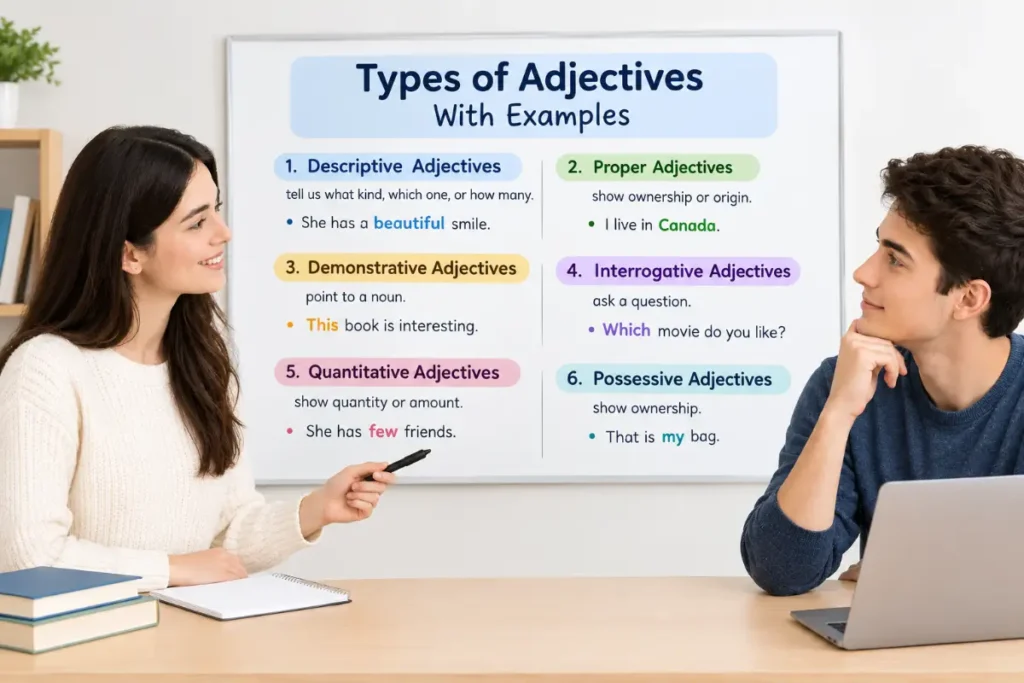
Here are the types of adjectives with examples that cover nearly every adjective you’ll meet in everyday writing, sorted into two big families: words that describe a noun and words that limit it. Once you can tell those two families apart, the smaller categories inside them (articles, possessives, demonstrative adjectives, numbers, and more) fall into place quickly.
The sorting matters because adjectives behave differently depending on their type. Some can be stacked and compared, some can’t, and a few look identical to pronouns until you check whether a noun follows them. This guide walks through each type with clear examples, then covers the special categories that don’t fit neatly into either family.
You may also find Examples of Intransitive Verbs: 20+ Easy Examples (2026 Guide) helpful if you want to explore this topic further.
The Two Big Families
Thesaurus.com’s guide to the types of adjectives draws the main line: descriptive adjectives describe the characteristics, traits, or qualities of a noun or pronoun, while limiting adjectives restrict a noun or pronoun rather than describe its qualities.
- a friendly neighbor (descriptive: tells you what kind)
- my neighbor (limiting: tells you whose)
Both sit in front of the noun and modify it, but only the first one adds a quality. The second one narrows down which neighbor you mean.
Descriptive Adjectives
These are the most common type, and the ones most people think of first. They answer “what kind?” and cover color, size, shape, age, feeling, and opinion.
- a purple scarf
- an attractive design
- a tired, grumpy student
- the enormous old house
Descriptive adjectives can usually be made stronger or weaker with words like “very” or “quite,” and most can be compared: tall, taller, tallest.
Where Descriptive Adjectives Sit
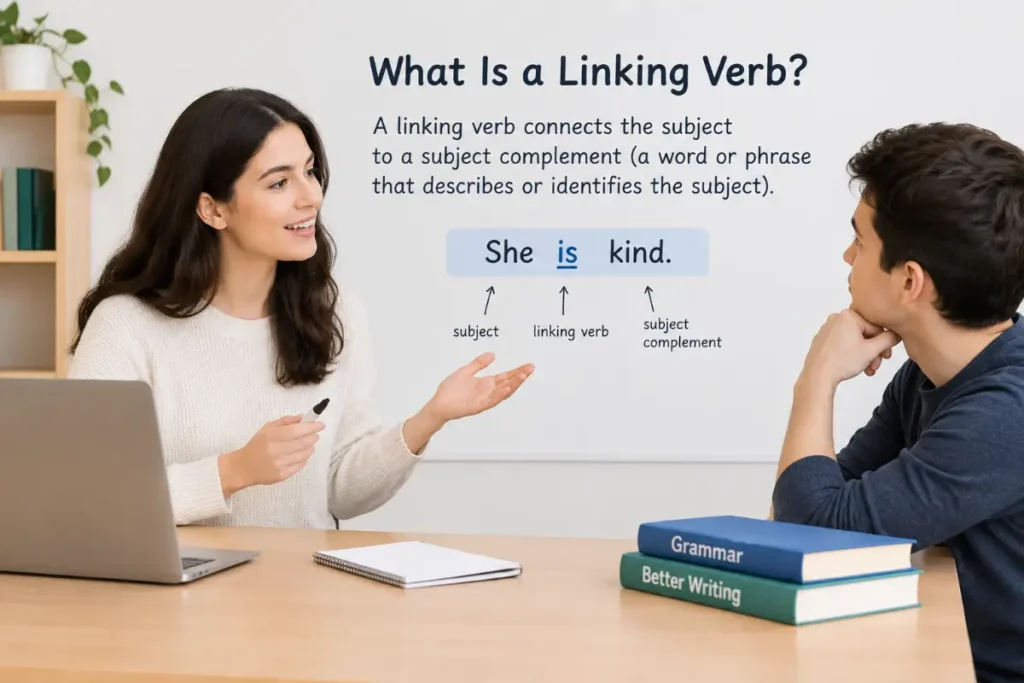
A descriptive adjective can come before the noun it describes (attributive position) or after a linking verb (predicate position).
- The hot soup burned my tongue. (before the noun)
- The soup is hot. (after the linking verb “is”)
The second pattern is why a word like “feel” or “taste” is followed by an adjective rather than an adverb, since those are linking verbs.
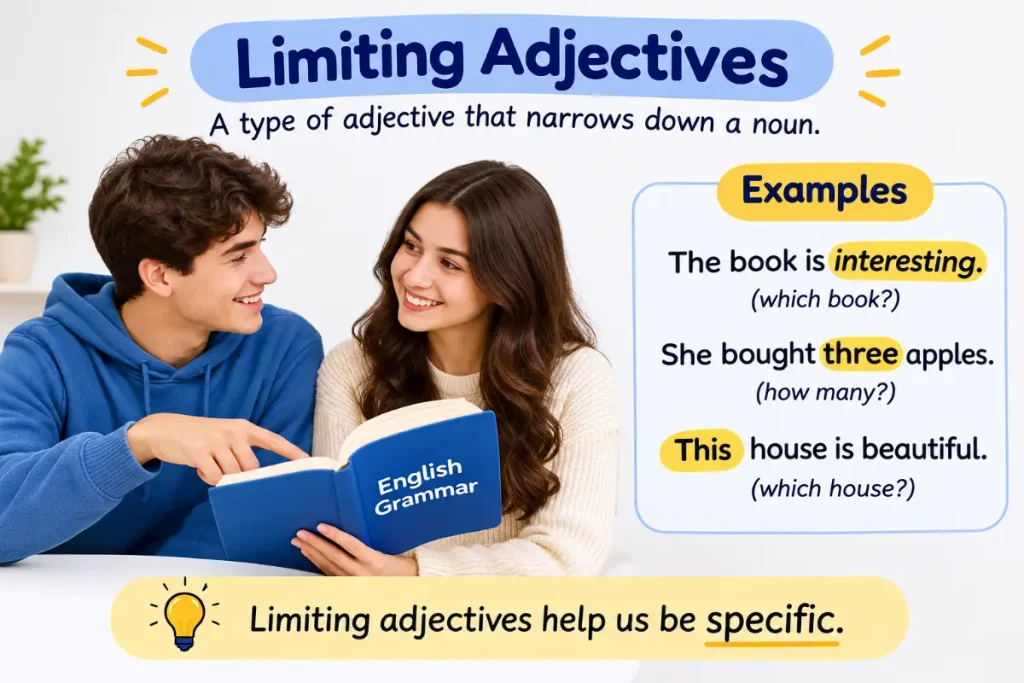
Limiting Adjectives
Limiting adjectives don’t describe a noun’s qualities. They pin down which one, how many, or whose. They fall into several subtypes.
Articles
The three articles are a, an, and the. “The” points to a specific noun, while “a” and “an” point to a non-specific one.
- The dog barked. (a particular dog)
- A dog barked. (some dog)
Possessive Adjectives
These show ownership: my, your, his, her, its, our, their, and whose.
- My sister called.
- Their house is on the corner.
These words never take an apostrophe, which is why “its” and “it’s” get mixed up so often.
Demonstrative Adjectives
The four demonstrative adjectives are this, that, these, and those. Thesaurus.com notes they express relative positions in space and time: this and these for things nearby, that and those for things farther away.
- This cake is delicious.
- Those shoes belong to my brother.
Numbers (Cardinal and Ordinal)
Cardinal numbers say how many, and ordinal numbers say what position.
- She ate three apples. (cardinal)
- He finished in second place. (ordinal)
Indefinite and Quantity Adjectives
These express an amount or a general reference without naming an exact number: some, many, few, several, each, every, any, no.
- Several students raised their hands.
- Every player received a medal.
Interrogative Adjectives
Which and what act as adjectives when they come directly before a noun in a question.
- Which book did you choose?
- What time is it?
The Pronoun Trap
Several limiting adjectives share their spelling with pronouns, and the only difference is whether a noun follows.
- This book is mine. (“this” modifies “book,” so it’s an adjective)
- This is mine. (“this” stands alone, so it’s a pronoun)
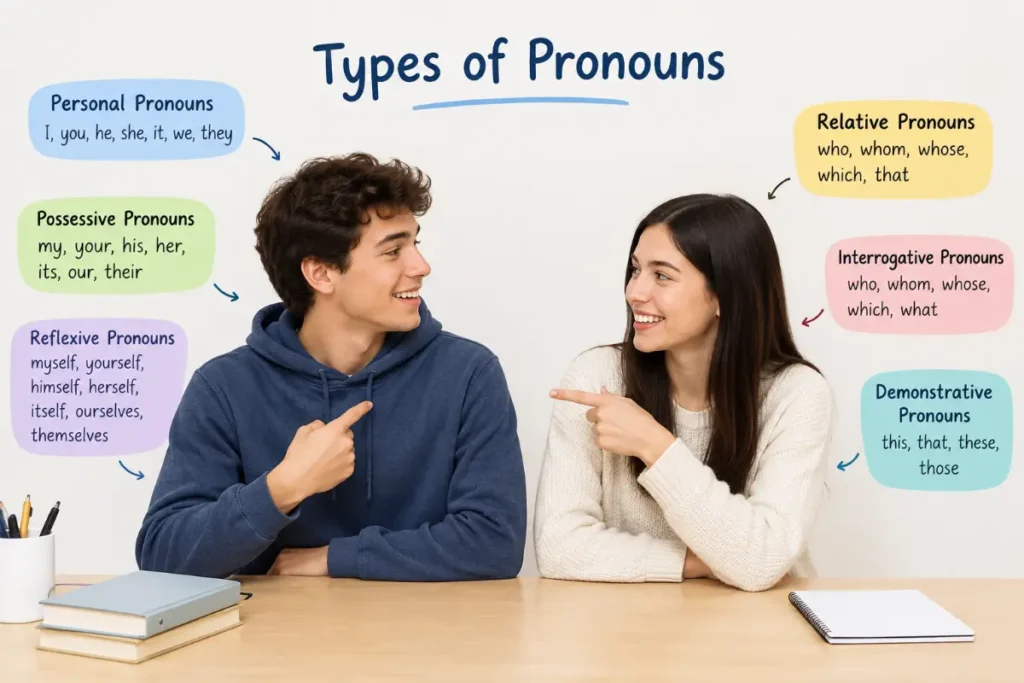
If a noun comes right after the word, you’re looking at an adjective. If the word replaces the noun, it’s a pronoun. Our guide to types of pronouns covers the pronoun side of this overlap.
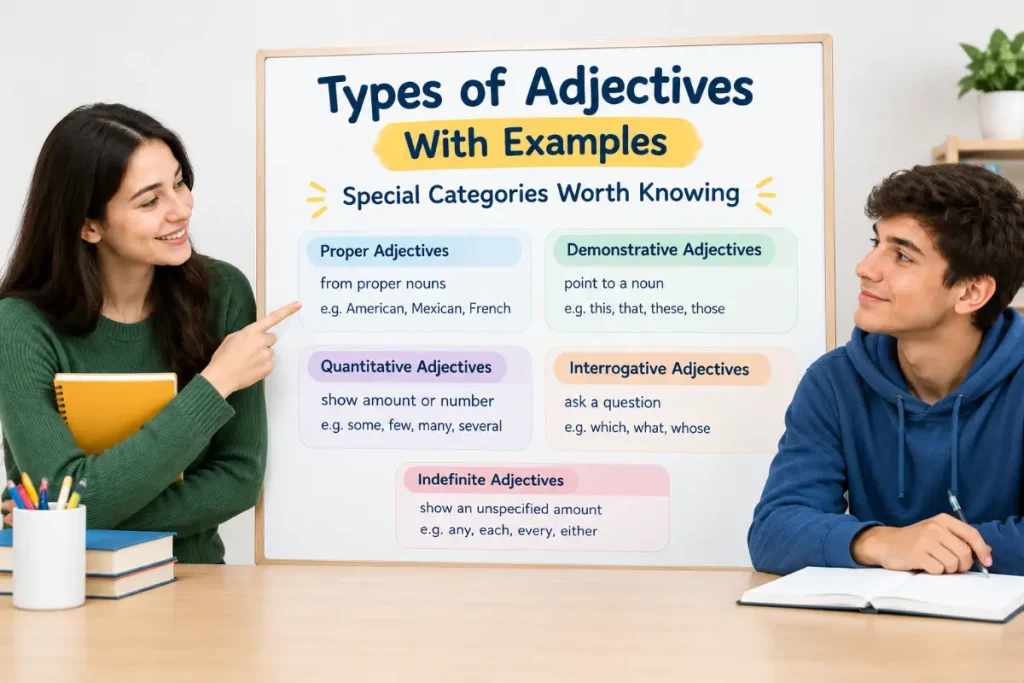
Special Categories Worth Knowing
Proper Adjectives
A proper adjective is formed from a proper noun and keeps its capital letter: Spanish rice, Victorian architecture, Shakespearean drama. The capitalization logic is the same one that applies to proper nouns.
Compound Adjectives
These combine two or more words into one modifier, usually joined by hyphens before a noun: well-known author, long-term plan, five-year-old child.
Participial Adjectives
A participle (an -ing or -ed verb form) can work as an adjective: the broken window, the sleeping baby, a tired traveler. When a participle gains its own modifiers or objects, it becomes a participial phrase, the subject of our guide to what is a participial phrase.
Comparative and Superlative Adjectives
These show degree: taller (comparing two), tallest (comparing three or more), more interesting, most interesting.
Adjective Order: How to Use Multiple Adjectives Correctly
When two or more adjectives describe the same noun, their order usually follows a natural pattern in English. Although you can sometimes change the order for emphasis, placing adjectives in the conventional order makes your writing sound more natural.
A common adjective order is:
Opinion → Size → Age → Shape → Color → Origin → Material → Purpose → Noun
For example:
- A beautiful small old house
- A large round wooden table
- A lovely little red dress
- An expensive new Italian sports car
- A small black leather bag
You don’t need to use every category in one sentence. The order simply helps when several adjectives appear together.
Compare these examples:
Natural: She bought a beautiful old French painting.
Less natural: She bought a French beautiful old painting.
In the first sentence, the adjectives follow a more conventional order: opinion, age, and origin.
Also, remember the difference between coordinate and cumulative adjectives. Coordinate adjectives describe a noun equally and can often be joined with and, so they take a comma: a bright, cheerful room. Cumulative adjectives build on one another and generally don’t take commas: three small wooden chairs.
Understanding adjective order helps you use multiple descriptive words without making your sentences sound awkward.
Coordinate vs. Cumulative Adjectives
When several adjectives describe the same noun, the comma question depends on whether they’re equal in weight. Equal (“coordinate”) adjectives take commas, and layered (“cumulative”) adjectives don’t.
- a bright, cheerful room (coordinate: you could say “bright and cheerful”)
- three small wooden chairs (cumulative: the adjectives build on each other in a fixed order)
This is covered in detail in our guide to how to use commas in a list.
Types of Adjectives With Examples in Sentences
Adjectives make sentences more specific by describing nouns or narrowing down which people, places, things, or ideas we mean. Seeing different types of adjectives in complete sentences makes it easier to understand how each type works.
- Descriptive adjective: The friendly teacher greeted everyone at the door.
- Possessive adjective: My brother bought a new laptop.
- Demonstrative adjective: Those flowers need more sunlight.
- Number adjective: She adopted two puppies from the shelter.
- Indefinite adjective: Several students stayed after class.
- Interrogative adjective: Which movie do you want to watch?
- Proper adjective: We ordered Italian food for dinner.
- Compound adjective: He works for a well-known company.
- Participial adjective: The broken window needs to be repaired.
- Article: The car is parked outside.
Each adjective performs a slightly different job. Words such as friendly describe a quality, while my, those, and two help identify or limit the noun. Recognizing these differences helps you choose the right adjective and build clearer sentences.
Quick Reference Table
| Type | Question It Answers | Examples |
|---|---|---|
| Descriptive | What kind? | red, tall, friendly, ancient |
| Article | Which one (specific or not)? | a, an, the |
| Possessive | Whose? | my, your, his, her, our, their |
| Demonstrative | Which one (near or far)? | this, that, these, those |
| Number | How many? Which position? | three, second |
| Indefinite | How much or how many (roughly)? | some, many, few, every |
| Interrogative | Which? What? (in a question) | which, what |
| Proper | Which nationality or origin? | Spanish, Victorian |
| Compound | What kind (combined)? | well-known, long-term |
| Participial | What kind (from a verb)? | broken, sleeping |
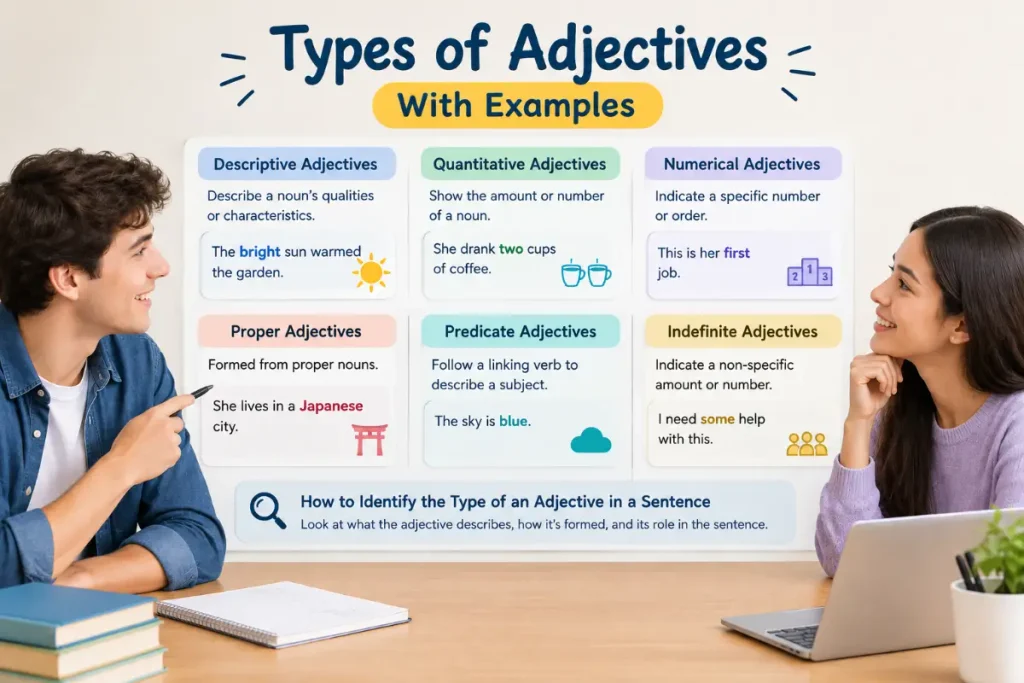
How to Identify the Type of an Adjective in a Sentence
You don’t have to memorize every adjective to identify its type. Instead, look at the job the word performs and ask what information it provides about the noun.
Follow these simple steps:
Step 1: Find the noun. Identify the person, place, thing, or idea being discussed.
For another useful perspective, check out Types of Pronouns: 9 Essential Types With Easy Examples (2026).
Step 2: Identify the modifying word. Look for a word that describes the noun or helps specify it.
Step 3: Ask what the word tells you. Does it describe a quality, show ownership, indicate quantity, or identify a particular noun?
Step 4: Classify the adjective. Match its function to the appropriate category.
Consider these examples:
| Sentence | Adjective | Type |
|---|---|---|
| She wore a beautiful dress. | beautiful | Descriptive |
| Our team won the championship. | our | Possessive |
| These cookies taste delicious. | these | Demonstrative |
| He purchased five notebooks. | five | Number |
| Every student received a certificate. | every | Indefinite |
| Which road leads to the airport? | which | Interrogative |
Remember that a word’s function matters more than its spelling alone. For example, this is an adjective in “this book” because it modifies the noun book. In “this is mine,” it functions as a pronoun because it stands alone.
Common Mistakes People Make
- Mistake 1: Treating a demonstrative as an adjective when no noun follows it. “This is mine” uses a pronoun, not an adjective.
- Mistake 2: Adding an apostrophe to a possessive adjective, writing “it’s tail” instead of “its tail.”
- Mistake 3: Forgetting the capital letter on a proper adjective, as in “a french pastry” instead of “a French pastry.”
- Mistake 4: Placing a comma between cumulative adjectives, as in “a small, wooden chair” when the natural order is “a small wooden chair.”
- Mistake 5: Using an adverb after a linking verb where an adjective is needed, such as “she looks nicely” instead of “she looks nice.”
Practice Exercise
Name the type of adjective shown in brackets: descriptive, article, possessive, demonstrative, number, indefinite, interrogative, proper, compound, or participial. Answers are listed right after, so try each one before checking.
- She wore a [red] scarf.
- [The] dog barked all night.
- [My] sister called this morning.
- [Those] shoes are mine.
- He ate [three] apples.
- She finished in [second] place.
- [Some] guests left early.
- [Which] book did you choose?
- We visited a [Spanish] village.
- He is a [well-known] author.
- The [broken] window needs repair.
- [Several] students raised their hands.
- [Our] team won the game.
- [This] cake is delicious.
- She has a [friendly] smile.
- [What] time is it?
- The [sleeping] baby smiled.
- [A] cat sat on the mat.
- [Many] people attended the concert.
- The soup is [hot].
Answer Key
- Descriptive
- Article
- Possessive
- Demonstrative
- Number (cardinal)
- Number (ordinal)
- Indefinite
- Interrogative
- Proper
- Compound
- Participial
- Indefinite
- Possessive
- Demonstrative
- Descriptive
- Interrogative
- Participial
- Article
- Indefinite
- Descriptive (predicate position)
Frequently Asked Questions
What’s the difference between a descriptive and a limiting adjective?
A descriptive adjective tells you about the qualities of a noun, like “tall” or “friendly.” A limiting adjective narrows down which noun you mean, with words like “my,” “this,” “three,” or “the.”
Are articles really adjectives?
Many grammar guides classify “a,” “an,” and “the” as limiting adjectives, while others call them determiners. Either label describes the same job: they point to a noun and mark whether it’s specific or general.
How can I tell if “this” or “that” is an adjective or a pronoun?
Check whether a noun follows it. “This book” uses “this” as an adjective, while “This is mine” uses it as a pronoun standing in for a noun.
Can a noun act as an adjective?
Yes. In phrases like “school bus” or “kitchen table,” the first noun modifies the second, and many grammar guides treat these as noun adjuncts. They function like adjectives even though the words are nouns.
What’s the fastest way to identify the type of an adjective?
Ask what the word tells you about the noun. If it describes a quality, it’s descriptive. If it tells you whose, which, how many, or whether the noun is specific, it’s a limiting adjective of the matching subtype.
Before moving on, you may also want to read A Predicate in a Sentence? A Simple 2026 Guide for more helpful grammar tips.
Wrapping Up
Learning the types of adjectives with examples gives you a map of how these words behave: descriptive adjectives add qualities and can usually be compared, while limiting adjectives (articles, possessives, demonstratives, numbers, indefinites, and interrogatives) narrow down which noun you mean. Proper, compound, and participial adjectives are specialized forms that follow their own capitalization, hyphenation, and punctuation habits.
When a word could be an adjective or a pronoun, the noun test settles it in a second: if a noun follows, it’s an adjective. That one check clears up most of the confusion around words like this, that, some, and many.