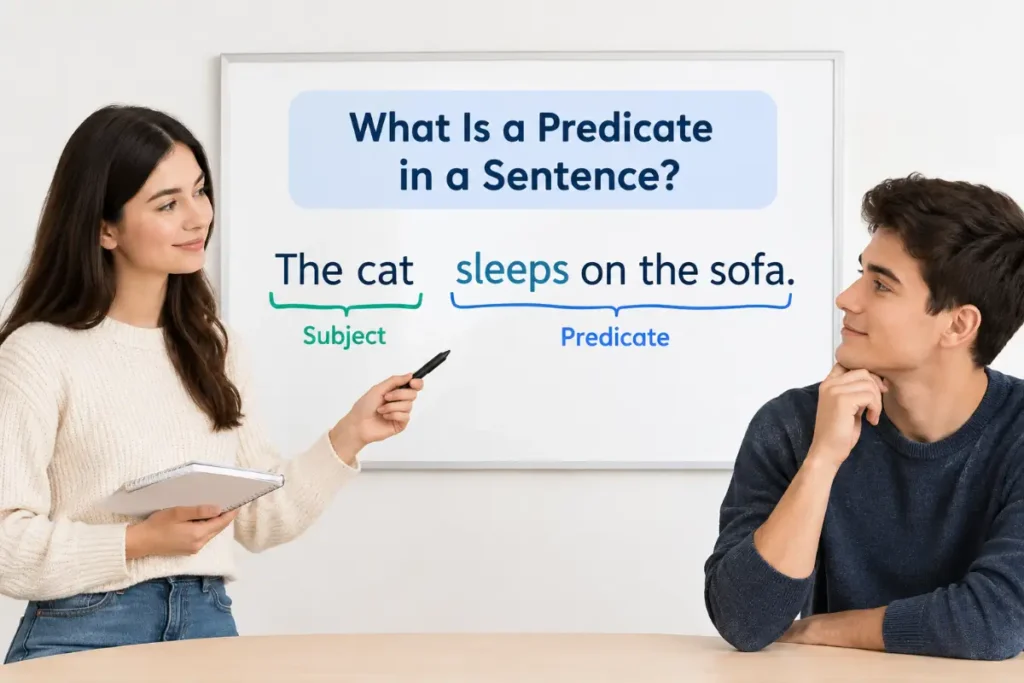
Here’s the simplest answer to what is a predicate in a sentence: it’s everything that isn’t the subject. A university sentence-structure guide puts it plainly: “the two essential parts of a sentence are the subject and the predicate,” where the subject names the topic being discussed and the predicate carries the verb and tells you what’s happening to, or being said about, that subject.
In “The engineers stood around the table,” “the engineers” is the subject, and “stood around the table” is the entire predicate. This guide covers the difference between a simple and a complete predicate, the compound predicate that trips up comma rules, and how to find the predicate in a sentence quickly, even when it’s a long one.
You may also find Examples of Intransitive Verbs: 20+ Easy Examples (2026 Guide) helpful if you want to explore this topic further.
Simple Predicate vs. Complete Predicate
The simple predicate is just the main verb (and any helping verbs attached to it) with nothing else included. The complete predicate is the verb plus every word that goes with it, including objects, modifiers, and complements.
- The engineers stood around the table looking at the schematics for the machine.
Here, the simple predicate is just “stood.” The complete predicate is “stood around the table looking at the schematics for the machine,” which includes three modifying phrases attached to that one verb.
- She quickly finished her homework before dinner.
Simple predicate: “finished.” Complete predicate: “quickly finished her homework before dinner.”
Finding the Predicate: A Two-Step Process
Step 1: Find the subject first. Ask who or what the sentence is about.
Step 2: Everything else is the predicate. Once you’ve identified the subject, the rest of the sentence, verb included, is the predicate by definition.
- My neighbor’s dog barks loudly every single morning.
Subject: “my neighbor’s dog.” Predicate: “barks loudly every single morning.”
Compound Predicates: One Subject, Multiple Actions
A compound predicate happens when one subject performs two or more actions, joined by a coordinating conjunction like “and” or “but,” without the subject being repeated.
- She cooked dinner and cleaned the kitchen.
This is a single sentence with one subject (“she”) and a compound predicate made of two verb phrases (“cooked dinner” and “cleaned the kitchen”). This distinction matters for comma placement: a compound predicate does not need a comma before “and,” since there’s only one subject doing two things, not two separate independent clauses.
- Correct: She cooked dinner and cleaned the kitchen. (no comma — compound predicate)
- Correct: She cooked dinner, and he cleaned the kitchen. (comma — two independent clauses, two different subjects)
This exact distinction is covered in more depth in our guide to comma before and rule, since the compound predicate is the single most common reason people mistakenly add an unnecessary comma before “and.”
Predicates With Linking Verbs
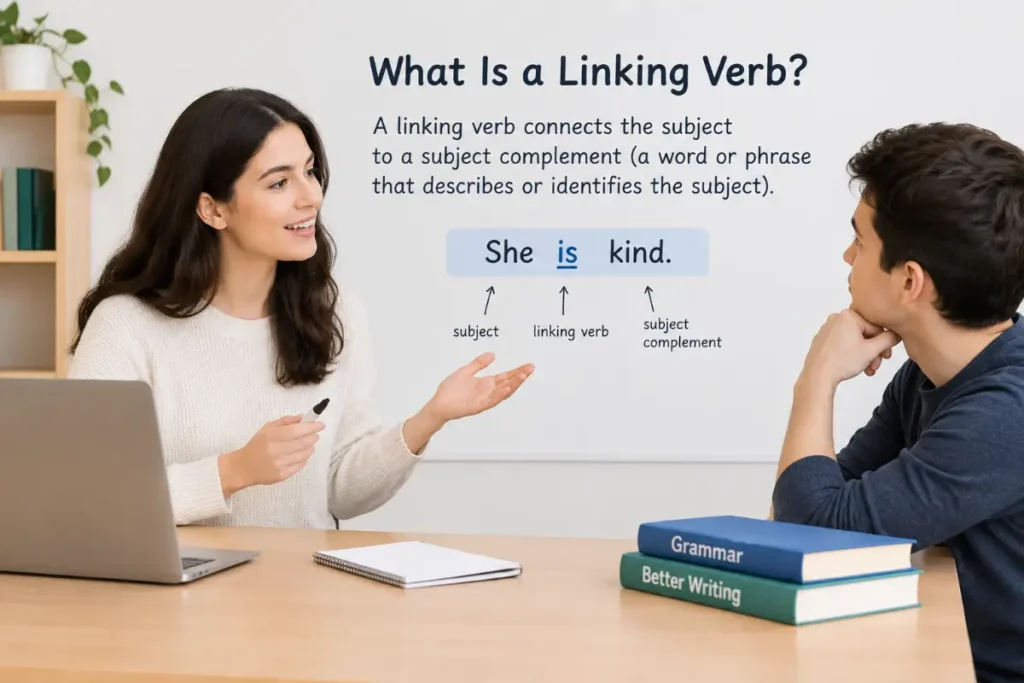
A predicate doesn’t always describe an action. When the sentence’s verb is a linking verb, the predicate instead connects the subject to a description or renaming of it, called a subject complement.
- The soup tastes delicious. (predicate: “tastes delicious,” linking “soup” to the description “delicious”)
- She is a teacher. (predicate: “is a teacher,” linking “she” to the renaming “a teacher”)
Our guide to what is a linking verb covers this connecting function in more depth, including the swap test for identifying a linking verb.
Predicates in Complex Sentences
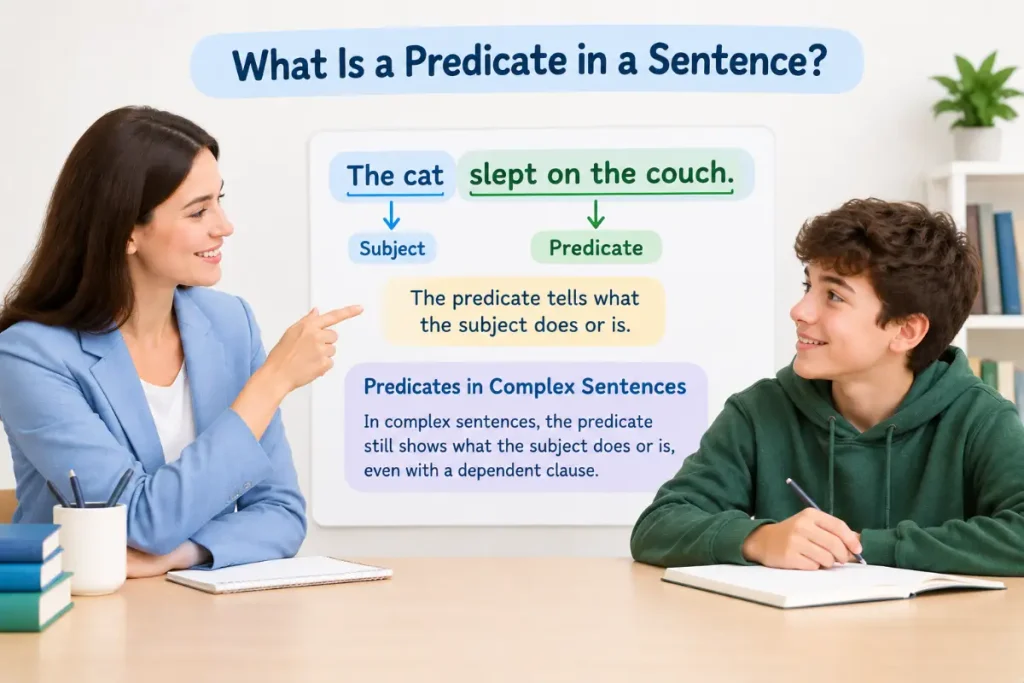
In a sentence with more than one clause, each clause has its own subject and its own predicate. Purdue OWL’s own example from its sentence structure materials shows this clearly:
- After they discussed different options, they decided to redesign the components.
This sentence has two subject-verb pairs: “they discussed” (in the dependent clause) and “they decided” (in the independent clause), each with its own predicate: “discussed different options” and “decided to redesign the components.” The two clauses are joined by the subordinating conjunction “after.”
Why the Predicate Matters for Fragments
A sentence fragment often happens specifically because the predicate is missing or incomplete. Our guide to how to fix a sentence fragment covers this in detail, but it’s worth noting here directly: a group of words with a subject but no real predicate, or a predicate with an incomplete verb, isn’t a complete sentence.
- The team, exhausted after the long game. (subject plus a modifying phrase, but no actual predicate — a fragment)
- The team was exhausted after the long game. (now has a complete predicate: “was exhausted after the long game”)
Predicate vs. Subject: What’s the Difference?
Every complete sentence has a subject and a predicate, and knowing the difference between them makes sentence structure much easier to understand. The subject tells you who or what the sentence is about, while the predicate tells you something about that subject. In other words, the subject is the topic, and the predicate contains the verb and the information connected to it.
Consider this example:
The young athlete won the race easily.
- Subject: “The young athlete”
- Predicate: “won the race easily”
The subject identifies who performed the action. The predicate tells us what that person did and adds information about the action.
Here are a few more examples:
The baby slept peacefully.
Subject: “The baby”
Predicate: “slept peacefully”
My older sister works at a hospital.
Subject: “My older sister”
Predicate: “works at a hospital”
The flowers in the garden look beautiful.
Subject: “The flowers in the garden”
Predicate: “look beautiful”
A useful way to remember the difference is to find the subject first. Ask who or what is the sentence about? Once you’ve found it, the rest of the sentence forms the predicate.
This becomes especially helpful with longer sentences. In “The students in the back row finished their assignments before lunch,” the entire phrase “The students in the back row” is the subject, not just “students.” Everything after it—”finished their assignments before lunch”—is the complete predicate.
Predicate vs. Verb: Are They the Same Thing?
A predicate and a verb are closely connected, but they aren’t the same thing. The verb is the central part of the predicate, while the predicate can contain additional words that complete or modify the meaning of that verb.
For example:
The dog barked loudly at the stranger.
The verb is “barked.”
The complete predicate is “barked loudly at the stranger.”
The words “loudly” and “at the stranger” provide additional information about the action, so they belong to the complete predicate even though they aren’t verbs.
For another useful perspective, check out Complete List of Relative Pronouns (2026 Guide).
The difference becomes even clearer with a linking verb:
Maria is a talented musician.
The verb is “is.”
The complete predicate is “is a talented musician.”
The predicate includes the verb plus the subject complement that describes or identifies Maria.
Helping verbs also remain part of the predicate:
The children have been playing outside.
The verb phrase “have been playing” forms the core of the predicate, while “outside” provides additional information.
So, if you’re asked to identify the verb, look for the action or linking verb (including its helping verbs). If you’re asked to identify the predicate, include the verb and the rest of the words that tell you what the subject does, is, has, or experiences.
Predicate Noun vs. Predicate Adjective
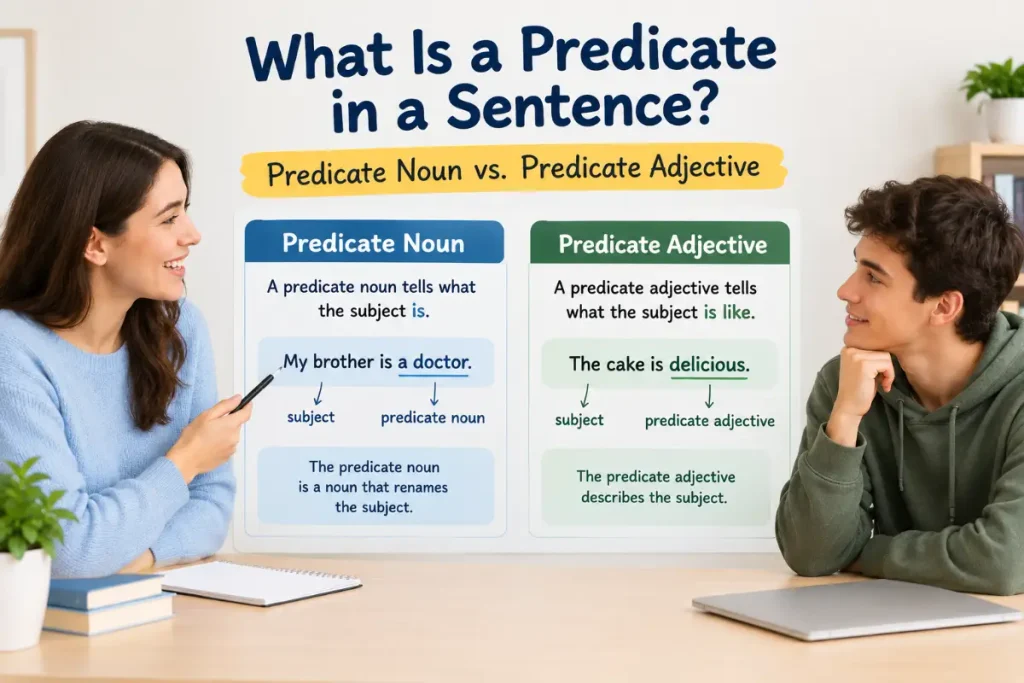
When a sentence uses a linking verb, the predicate can contain a word or phrase that describes the subject or renames it. These are called subject complements, and two common types are predicate nouns and predicate adjectives.
A predicate noun renames or identifies the subject:
Jordan is a teacher.
- Subject: “Jordan”
- Linking verb: “is”
- Predicate noun: “teacher”
- Complete predicate: “is a teacher”
The word “teacher” doesn’t describe an action. It tells us what Jordan is.
A predicate adjective, on the other hand, describes the subject:
Jordan is talented.
- Subject: “Jordan”
- Linking verb: “is”
- Predicate adjective: “talented”
- Complete predicate: “is talented”
Here, “talented” describes Jordan rather than renaming Jordan.
Compare these examples:
| Sentence | Type | Complement |
|---|---|---|
| Lisa is a doctor. | Predicate noun | “doctor” |
| Lisa is tired. | Predicate adjective | “tired” |
| The building became a hotel. | Predicate noun | “hotel” |
| The building became crowded. | Predicate adjective | “crowded” |
| My brother seems a good candidate. | Predicate noun | “a good candidate” |
| My brother seems confident. | Predicate adjective | “confident” |
A quick test is to ask whether the word renames the subject or describes the subject. If it renames the subject, you’re dealing with a predicate noun. If it describes the subject, it’s a predicate adjective. Both are part of the predicate and usually follow a linking verb.
Quick Reference Table
| Sentence | Subject | Simple Predicate | Complete Predicate |
|---|---|---|---|
| The dog barked loudly. | The dog | barked | barked loudly |
| She is a nurse. | She | is | is a nurse |
| They cooked and cleaned. | They | cooked, cleaned | cooked and cleaned |
| The engineers stood around the table. | The engineers | stood | stood around the table |
Common Mistakes People Make
- Mistake 1: Adding an unnecessary comma before “and” in a compound predicate, treating it as though it were joining two separate sentences.
- Mistake 2: Confusing the simple predicate with the complete predicate when asked to identify “the predicate” of a sentence, especially in longer sentences with multiple modifying phrases.
- Mistake 3: Mistaking a long descriptive phrase for a predicate when no actual verb is present, producing a sentence fragment.
- Mistake 4: Forgetting that a predicate built on a linking verb connects to a description or renaming, not an action, which affects whether an adjective or adverb belongs after it.
- Mistake 5: Assuming every clause in a complex sentence shares the same subject, when dependent and independent clauses often each have their own distinct subject-predicate pair.
Practice Exercise
Identify the subject and the complete predicate in each sentence. Answers are listed right after, so try each one before checking.
- The children played outside all afternoon.
- She is an excellent teacher.
- The storm damaged several homes.
- My brother cooked dinner and washed the dishes.
- The old bridge finally collapsed last week.
- He seems confident about the results.
- The committee reviewed the proposal carefully.
- The flowers bloomed early this spring.
- They traveled to Spain and visited three cities.
- The soup tastes amazing tonight.
- The students studied quietly in the library.
- Our neighbor’s cat sleeps all day.
- The company launched a new product last month.
- She writes novels and teaches writing workshops.
- The mountain looked stunning at sunrise.
- He finished the marathon in record time.
- The dog barked and growled at the mail carrier.
- The museum opened a new exhibit this week.
- My parents are visiting next weekend.
- The team celebrated their victory loudly.
Answer Key
- Subject: The children. Predicate: played outside all afternoon.
- Subject: She. Predicate: is an excellent teacher.
- Subject: The storm. Predicate: damaged several homes.
- Subject: My brother. Predicate: cooked dinner and washed the dishes.
- Subject: The old bridge. Predicate: finally collapsed last week.
- Subject: He. Predicate: seems confident about the results.
- Subject: The committee. Predicate: reviewed the proposal carefully.
- Subject: The flowers. Predicate: bloomed early this spring.
- Subject: They. Predicate: traveled to Spain and visited three cities.
- Subject: The soup. Predicate: tastes amazing tonight.
- Subject: The students. Predicate: studied quietly in the library.
- Subject: Our neighbor’s cat. Predicate: sleeps all day.
- Subject: The company. Predicate: launched a new product last month.
- Subject: She. Predicate: writes novels and teaches writing workshops.
- Subject: The mountain. Predicate: looked stunning at sunrise.
- Subject: He. Predicate: finished the marathon in record time.
- Subject: The dog. Predicate: barked and growled at the mail carrier.
- Subject: The museum. Predicate: opened a new exhibit this week.
- Subject: My parents. Predicate: are visiting next weekend.
- Subject: The team. Predicate: celebrated their victory loudly.
Frequently Asked Questions
What’s the difference between a simple predicate and a complete predicate?
The simple predicate is just the main verb and any helping verbs. The complete predicate includes that verb plus every object, modifier, and complement attached to it, which means the complete predicate can stretch across most of a long sentence.
Can a sentence have more than one predicate?
A single clause has one predicate, but a sentence with multiple clauses, whether compound or complex, has one predicate for each clause, since each clause contains its own subject-verb pair.
Does a predicate always include an object?
No. A predicate always includes a verb, but whether it also includes a direct object depends on whether that verb is transitive. Intransitive verbs form complete predicates without any object at all, as in “the baby cried.”
How is a compound predicate different from a compound sentence?
A compound predicate has one subject performing multiple actions, joined within a single clause, and takes no comma before “and.” A compound sentence has two full independent clauses, each with its own subject, joined by a comma and a conjunction.
What’s the fastest way to identify the predicate in a sentence?
Find the subject first by asking who or what the sentence is about, then treat everything remaining in the sentence as the predicate, since those two parts together account for the entire sentence.
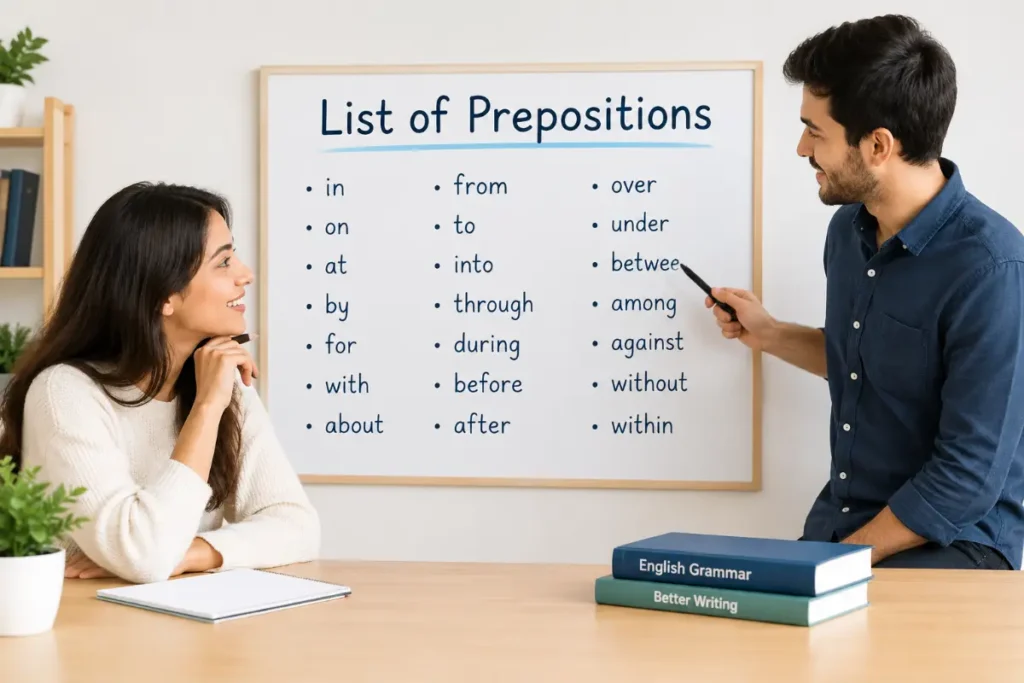
Before moving on, you may also want to read List of Prepositions: 100+ Words You Need to Know (2026) for more helpful grammar tips.
Wrapping Up
Understanding what is a predicate in a sentence comes down to a simple division: the subject names what the sentence is about, and the predicate, built around the verb, says something about that subject, whether that’s an action, a description, or a renaming through a linking verb.
The compound predicate is the detail most worth remembering day to day, since mistaking it for two separate clauses is exactly what leads to the most common unnecessary comma error before “and.” Once you can reliably split any sentence into its subject and predicate, spotting fragments, fixing comma mistakes, and analyzing more complex sentence structures all become noticeably easier.