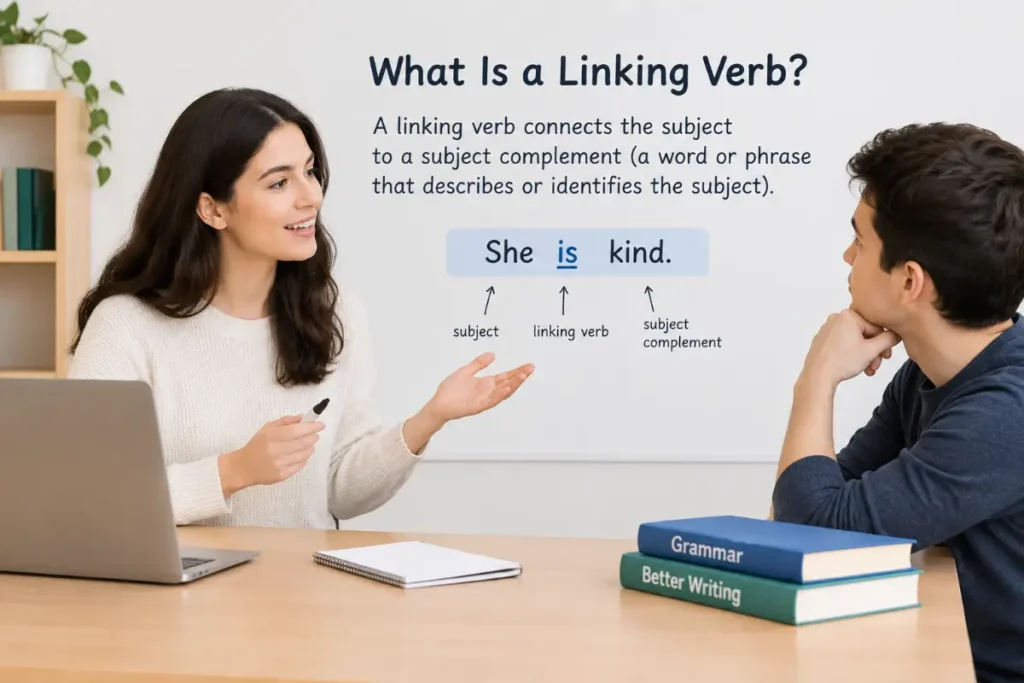
Here’s the short answer to what is a linking verb: it’s a verb that connects the subject of a sentence to a word that describes or renames it, rather than showing an action the subject performs. In “The soup smells delicious,” nothing is actually being done to the soup — “smells” simply links “soup” to the description “delicious.”
The reason this topic trips people up isn’t the definition itself. It’s that several linking verbs — smell, taste, look, feel, sound — can also function as ordinary action verbs, which means the exact same word can play two different roles depending on the sentence. This guide shows the full list of linking verbs, walks through a quick test for telling the two roles apart, and covers why this distinction quietly explains the “I feel good” debate too.
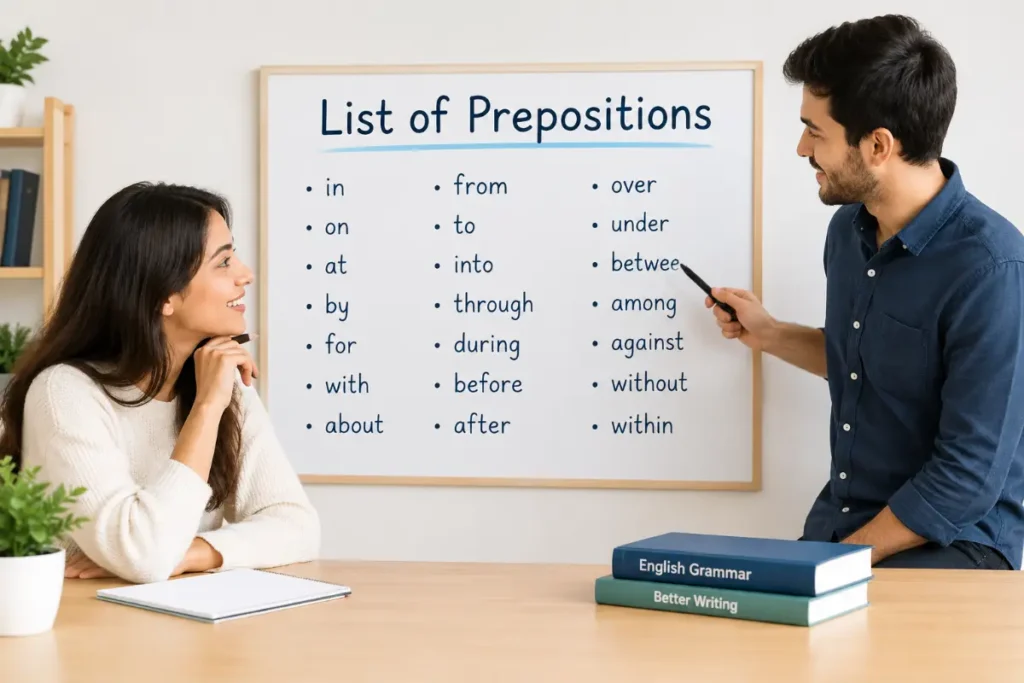
You may also find List of Prepositions: 100+ Words You Need to Know (2026) helpful if you want to explore this topic further.
The Core Definition
Excelsior OWL defines linking verbs plainly: they “join or link the subject of a sentence with the rest of the sentence,” making a statement by connecting ideas rather than describing an action. The word that follows a linking verb either renames the subject (a noun) or describes it (an adjective), and this word is called a subject complement.
- She is a teacher. (renames the subject — “teacher” is another way of identifying “she”)
- She seems tired. (describes the subject — “tired” is a quality of “she”)
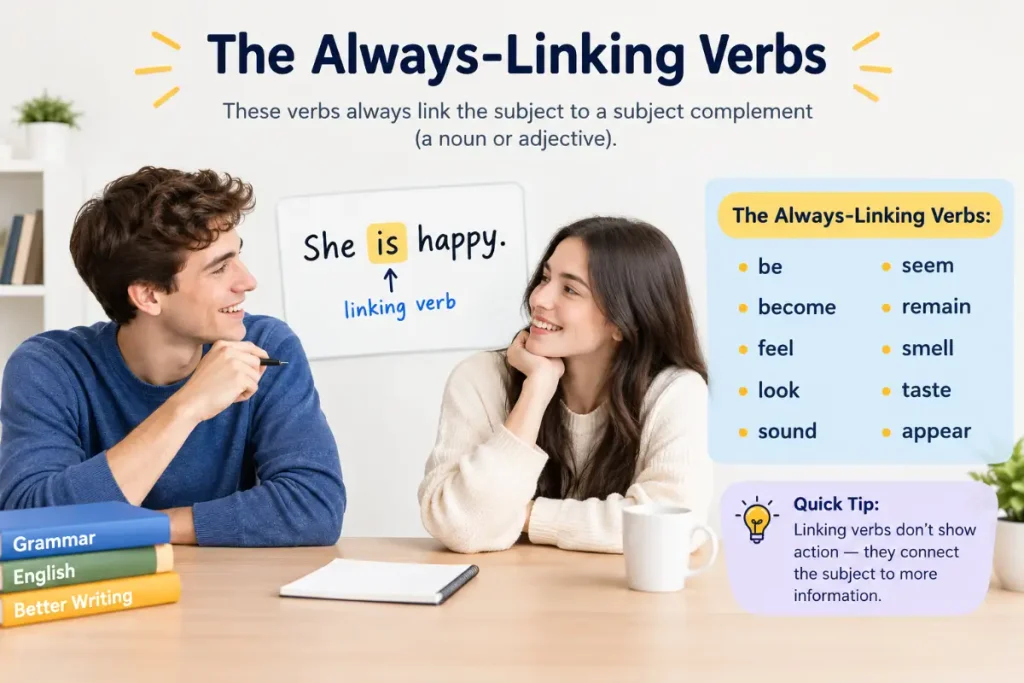
The Always-Linking Verbs
The “be” verbs are linking verbs in essentially every context: am, is, are, was, were, be, being, been.
- He is happy.
- They were students here.
- I am ready.
A small group of other verbs function as linking verbs almost all the time too, including become and seem.
- She became a doctor.
- He seems confident.
The Sometimes-Linking Verbs
This is the category that actually causes confusion, because these verbs can describe either a state (linking) or an action (not linking), depending entirely on the sentence. The most common ones are the “sense” verbs: feel, look, smell, sound, taste — along with a handful of others like appear, grow, remain, stay, and turn.
- The soup tastes salty. (linking — “tastes” connects “soup” to the description “salty”)
- She tasted the soup. (action — she performed the act of tasting something)
- He looks tired. (linking — “looks” connects “he” to “tired”)
- He looked at the clock. (action — looking is something he actively did, directed at an object)
The Swap Test: How to Tell the Two Apart
The fastest way to check whether one of these flexible verbs is linking or acting is to try replacing it with a form of “is,” “am,” or “are.” If the sentence still makes sense, it’s a linking verb.
- The soup tastes salty. → The soup is salty. (works — linking verb)
- She tasted the soup. → She is the soup. (nonsense — not a linking verb)
- He looks tired. → He is tired. (works — linking verb)
- He looked at the clock. → He is at the clock. (doesn’t carry the same meaning — not a linking verb here)
If the swap preserves the sentence’s meaning, the verb is linking the subject to a description. The verb is describing an action instead if the swap breaks the sentence.
Why This Explains “I Feel Good” vs. “I Feel Well”
This grammar point is exactly what resolves one of the most argued-about phrases in English. “Feel” is a linking verb when it describes your internal state, which means it should be followed by an adjective, not an adverb.
- I feel good. (“good” is an adjective describing your overall state — correct, since “feel” is linking)
- I feel well. (also correct, but “well” here functions as an adjective meaning “in good health,” a narrower claim about not being sick)
For the full breakdown of why “I feel good” has been getting unfairly corrected for a century, see our guide to good vs well.
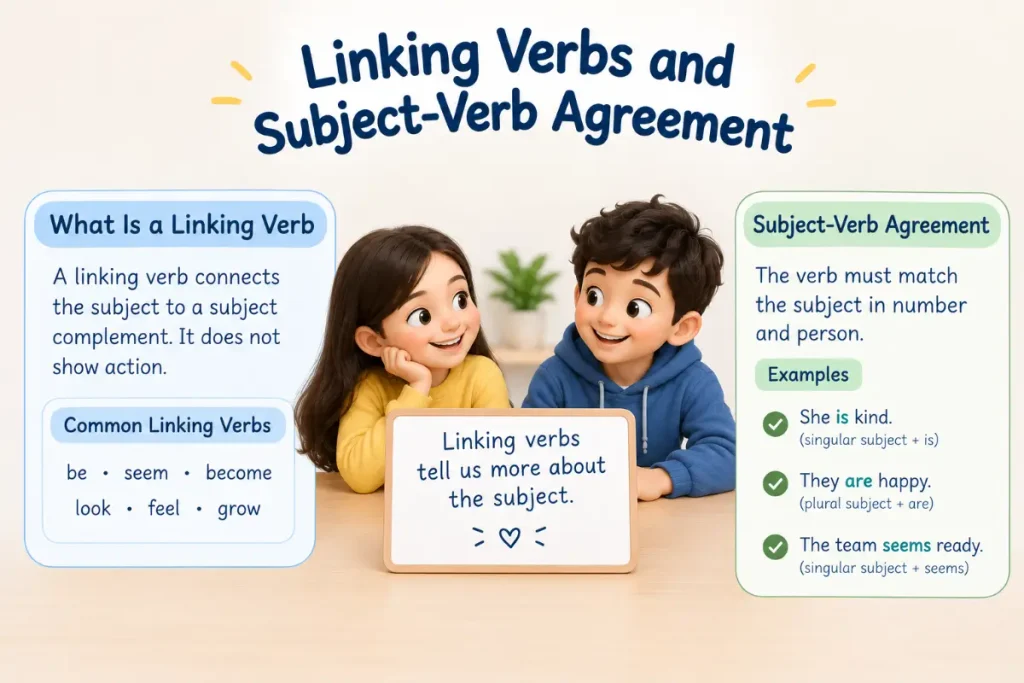
Linking Verbs and Subject-Verb Agreement
Linking verbs still need to agree in number with their subject, exactly like any other verb — the complement that follows has no effect on this.
- The problem is the budget. (singular subject “problem,” singular verb “is”)
- The problems are the budget and the timeline. (plural subject, plural verb)
This matters most when the complement after the verb doesn’t match the subject in number, since it’s tempting to accidentally agree with the nearer word instead of the true subject, a mistake covered more broadly in our guide to subject verb agreement rules.
Linking Verbs vs. Auxiliary Verbs
It’s worth separating linking verbs from auxiliary (helping) verbs, since several of the same words — especially the “be” verbs — can do both jobs. Excelsior OWL draws the key distinction: linking verbs join the subject and a complement that describes or renames it, while auxiliary verbs attach to another main verb to build a tense or mood.
- She is tired. (linking — “is” connects “she” to “tired”)
- She is running. (auxiliary — “is” is helping the main verb “running,” not linking to a complement)
What Is the Difference Between Linking Verbs and Action Verbs?
The main difference between linking verbs and action verbs is what they do in a sentence. A linking verb connects the subject to a word that describes or renames it, while an action verb tells what the subject does. Understanding this difference makes it easier to identify how a verb functions in context.
Consider these examples:
- Linking verb: The baby looks sleepy.
- Action verb: The baby looks at the toy.
- Linking verb: The cookies smell delicious.
- Action verb: Mom smells the cookies.
- Linking verb: The students became nervous.
- Action verb: The students completed the assignment.
In the first example of each pair, the verb connects the subject to a description or state. In the second, it expresses an action performed by the subject.
One important detail is that a verb’s function depends on how it is used in a sentence, not simply on which word appears. For instance, look can connect a subject to a description, as in “She looks happy,” or describe an action, as in “She looked through the window.”
When you are unsure, examine the words that follow the verb. If they describe or rename the subject, the verb may be linking. If the verb expresses an action, it is functioning as an action verb. You can also try replacing it with a form of be, while remembering that this substitution is a useful clue rather than a perfect test for every sentence.
What Words Follow a Linking Verb?
A linking verb is usually followed by a subject complement, a word or phrase that identifies, renames, or describes the subject. Unlike a direct object, a subject complement refers back to the subject rather than receiving an action.
There are two common types of subject complements: predicate adjectives and predicate nominatives.
Predicate Adjectives
A predicate adjective is an adjective that describes the subject after a linking verb.
Examples:
- The weather is pleasant.
- The soup tastes salty.
- The children seem excited.
- Her explanation sounds reasonable.
In each sentence, the bold word describes the subject. For example, pleasant describes the weather, and salty describes the soup.
Predicate Nominatives
A predicate nominative is a noun or pronoun that renames or identifies the subject.
Examples:
- Maria is a teacher.
- My brother became an engineer.
- The winner was she.
- Their main concern remains the budget.
Here, the bold words identify the subjects rather than describe their qualities. Maria is identified as a teacher, and the brother is identified as an engineer.
How Can You Tell the Difference?
Ask yourself what the word after the linking verb does. Does it describe the subject, or does it identify the subject as a person, place, thing, or role?
- Description: The flowers look beautiful. (Beautiful is a predicate adjective.)
- Identification: The flowers are gifts. (Gifts is a predicate nominative.)
Recognizing these two types of subject complements helps you understand sentence structure and avoid confusing linking verbs with verbs that take direct objects.
What Are the 12 Common Linking Verbs?
Many grammar lessons teach a group of 12 commonly used linking verbs: am, is, are, was, were, be, being, been, become, seem, appear, and feel. These are useful starting points, but they are not a complete list of every verb that can function as a linking verb.
Here are some examples:
- Am: I am ready.
- Is: The room is quiet.
- Are: The students are attentive.
- Was: The movie was exciting.
- Were: They were exhausted.
- Be: Be careful.
- Being: He is being difficult.
- Been: She has been helpful.
- Become: The sky became dark.
- Seem: The answer seems correct.
- Appear: The solution appears simple.
- Feel: I feel nervous.
Other verbs, including look, smell, sound, taste, grow, remain, stay, and turn, can also function as linking verbs in the right context.
Remember that lists are learning aids, not absolute rules. Some verbs can function as linking verbs in one sentence and action verbs in another.
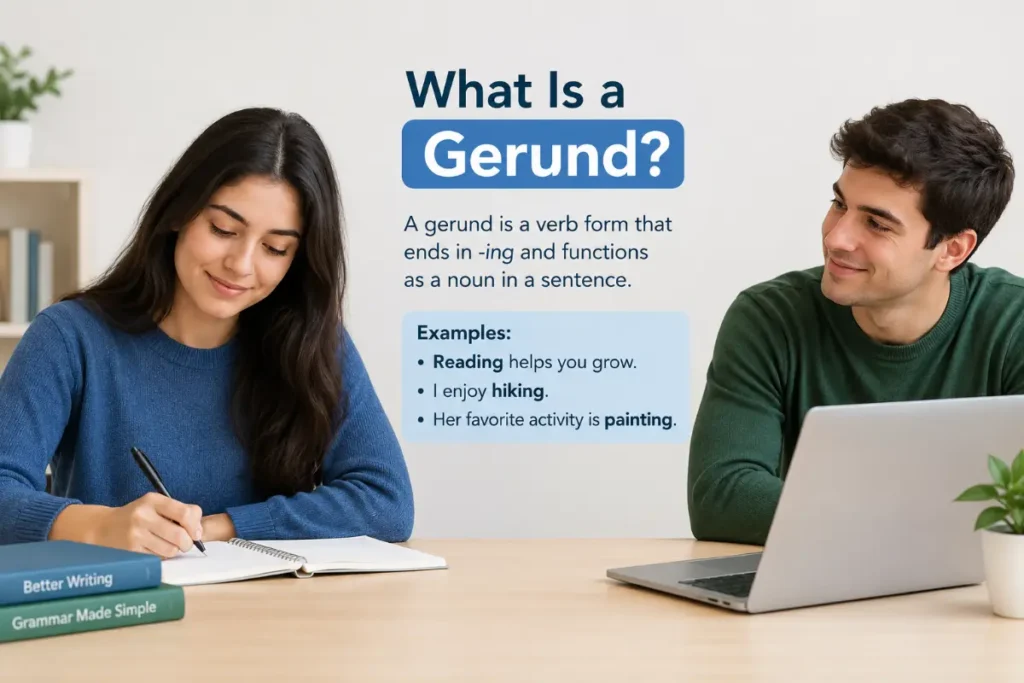
For another useful perspective, check out A Gerund? The -ing Word That Works as a Noun (2026).
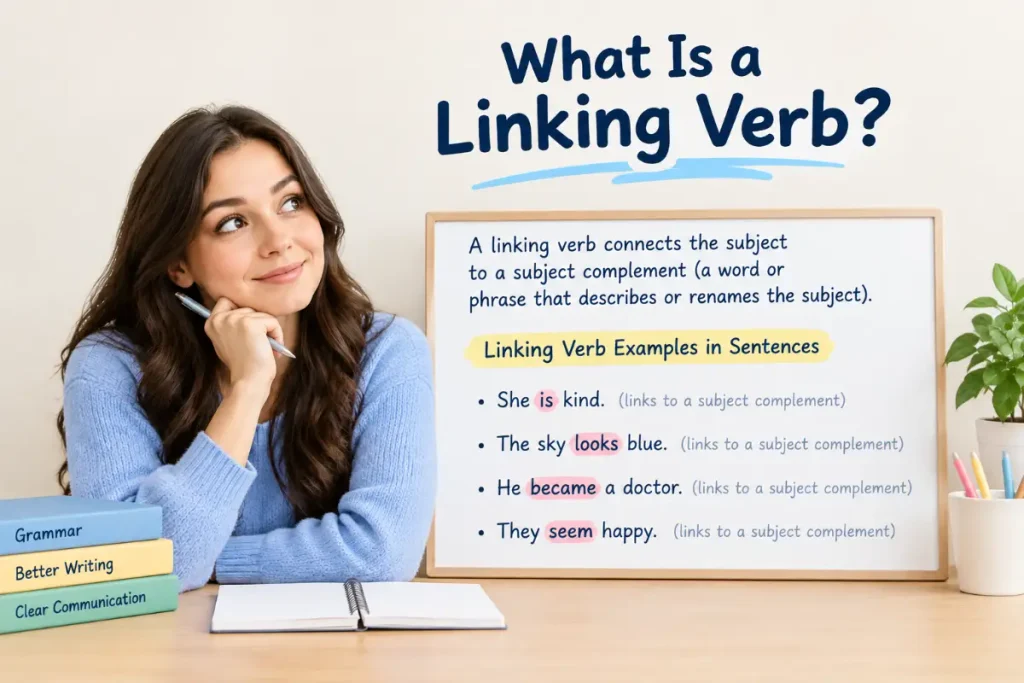
Linking Verb Examples in Sentences
The easiest way to understand linking verbs is to see how they connect subjects to descriptions or identities. In each example below, the linking verb joins the subject to information about that subject.
| Sentence | Linking Verb | What It Connects |
|---|---|---|
| The coffee smells strong. | smells | Coffee and its quality |
| My sister is a nurse. | is | Sister and her profession |
| The room feels cold. | feels | Room and its condition |
| The children seem happy. | seem | Children and their feelings |
| The leaves turned yellow. | turned | Leaves and their new color |
| His explanation sounds convincing. | sounds | Explanation and its quality |
| The old building remains empty. | remains | Building and its condition |
| The situation became serious. | became | Situation and its new state |
| Your idea appears practical. | appears | Idea and its quality |
| The milk tastes sour. | tastes | Milk and its flavor |
Notice that none of these verbs describes an action being performed on an object. Instead, each one connects the subject to a characteristic, condition, identity, or state.
To practice, cover the last two columns and identify the linking verb and the information it connects. This simple exercise can help you recognize linking verbs more quickly when reading or writing.
Quick Reference Table
| Verb | Linking Example | Action Example |
|---|---|---|
| taste | The cake tastes great. | She tasted the cake. |
| smell | The flowers smell wonderful. | He smelled the flowers. |
| look | She looks exhausted. | She looked at the map. |
| feel | I feel nervous. | She felt the fabric. |
| sound | That sounds reasonable. | He sounded the alarm. |
| grow | He grew anxious. | She grows tomatoes. |
| turn | The leaves turned brown. | He turned the key. |
Common Mistakes People Make
- Mistake 1: Using an adverb after a linking verb when an adjective is needed, as in “she feels badly” instead of “she feels bad,” since “feels” here is linking, not describing an action.
- Mistake 2: Assuming a word is always a linking verb just because it appears on a list, without checking the sentence it’s actually in.
- Mistake 3: Forgetting that linking verbs still need to agree with the subject, not with the complement that follows.
- Mistake 4: Confusing a linking “be” verb with an auxiliary “be” verb, which changes how the rest of the sentence should be analyzed.
- Mistake 5: Overcorrecting “I feel good” to “I feel well” in every context, when both are grammatically valid and simply mean slightly different things.
Practice Exercise
Decide whether the verb in each sentence is linking or acting as an action verb. Answers are listed right after, so try each one before checking.
- The milk smells sour.
- She smelled the fresh bread.
- He looks confident today.
- He looked through the window.
- The music sounds beautiful.
- The alarm sounded at six.
- She feels confident about the test.
- She felt the rough surface.
- The plan seems solid.
- He grew impatient waiting.
- She grows vegetables in her garden.
- The milk turned sour overnight.
- He turned the corner quickly.
- This soup tastes amazing.
- He tasted the sauce before serving it.
- They remained calm during the storm.
- The answer appears correct.
- She appeared at the door suddenly.
- He stayed quiet during the meeting.
- The children stayed at their grandparents’ house.
Answer Key
- Linking
- Action
- Linking
- Action
- Linking
- Action
- Linking
- Action
- Linking
- Linking
- Action
- Linking
- Action
- Linking
- Action
- Linking
- Linking
- Action
- Linking
- Action
Frequently Asked Questions
Can a sentence have more than one linking verb?
Not typically within a single clause, since a linking verb connects one subject to one complement at a time, though a longer sentence can contain multiple clauses, each with its own linking verb.
Is “become” always a linking verb?
Yes, in standard usage “become” functions as a linking verb in virtually every context, always connecting the subject to a word that describes or renames it, such as “she became a lawyer” or “he became anxious.”
How do linking verbs relate to passive voice?
They’re different constructions, though both can involve “be” verbs. Passive voice uses a “be” verb plus a past participle to show the subject receiving an action, while a linking verb connects the subject to a descriptive complement with no action involved at all.
Why do some grammar lists call these verbs “copular” verbs instead of linking verbs?
“Copular” is simply the more technical linguistic term for the same concept, borrowed from the Latin word for “link” or “couple.” Both terms describe verbs that connect a subject to a complement rather than expressing an action.
What’s the fastest way to check if a word is working as a linking verb?
Try substituting a form of “is,” “am,” or “are” in its place. If the sentence still makes sense with the same basic meaning, the original verb was linking the subject to a complement.
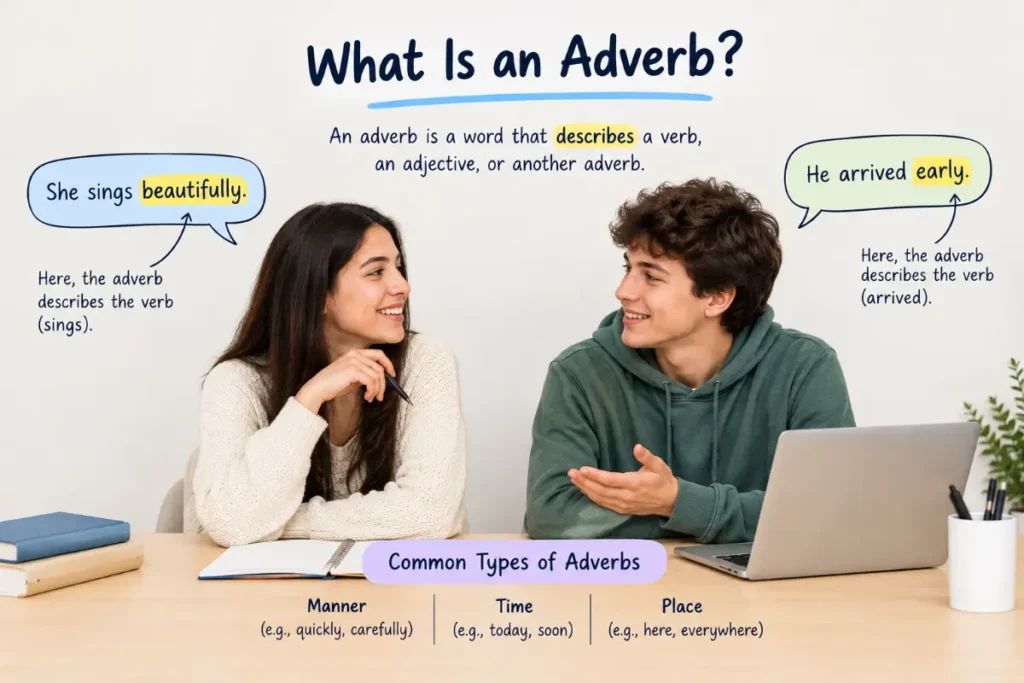
Before moving on, you may also want to read An Adverb? 25 Easy Examples to Understand It (2026) for more helpful grammar tips.
Wrapping Up
Understanding what is a linking verb comes down to recognizing that these verbs connect rather than act: the “be” verbs, “become,” and “seem” are linking verbs nearly all the time, while sense verbs like taste, feel, look, smell, and sound can go either way depending on what follows them. The swap test, replacing the verb with a form of “is,” settles the doubtful cases in seconds.
This distinction isn’t just a grammar curiosity. It’s the exact mechanism behind why “I feel good” is correct, why “she feels badly” is usually a mistake, and why the word right after these verbs should so often be an adjective rather than an adverb.