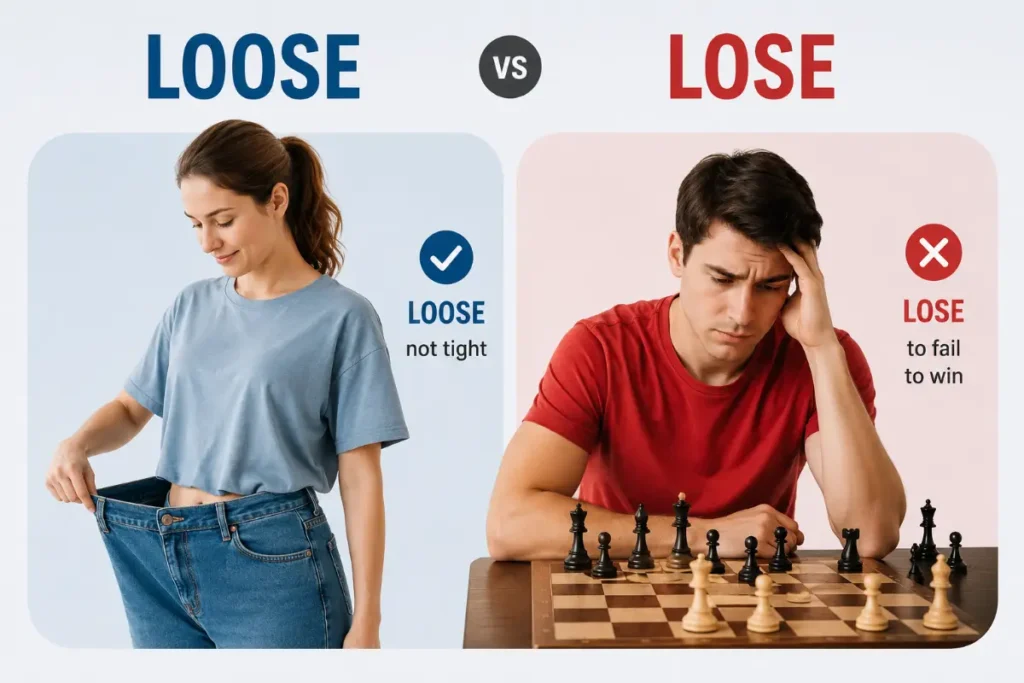
These two words look like they should rhyme, and they’re spelled almost identically—just one letter apart—but they’re pronounced differently and mean completely unrelated things. Loose vs Lose is one of the more purely visual mix-ups in English, and it has one of the cleanest, most reliable fixes on this entire site.
Loose (rhymes with “goose”) means not tight, not secure, or free from restraint. Lose (rhymes with “choose”) means to misplace something or fail to win. One extra letter separates them, and that letter is exactly what causes the confusion.
You may also find Farther vs Further: 5 Easy Rules to Get It Right (2026) helpful if you want to explore this topic further.
The Quick Answer
- Loose (two O’s) = not tight, not attached securely
- The screw is loose.
- Lose (one O) = to misplace something, or fail to win
- Don’t lose your keys.
The test: does the word rhyme with “goose” or “moose”? That’s loose. Does it rhyme with “choose” or “snooze”? That’s lose.
Try it: “These pants are too ___ around the waist.” Say it out loud — does it rhyme with “goose”? Yes — so it’s loose: “These pants are too loose around the waist.”
Now try: “I always ___ my phone charger.” Does it rhyme with “choose”? Yes — so it’s lose: “I always lose my phone charger.”
Why the Spelling Feels Backwards
Most English speakers expect double letters to make a word “bigger” or “longer” sounding, so it feels counterintuitive that “loose” (two O’s) is the simpler, more literal word, while “lose” (one O) is the one people default to spelling wrong by adding an extra O out of habit. Merriam-Webster notes this directly: because “lose” rhymes so closely with “choose” (which does have two O’s… wait, actually “choose” has “oo” too), people’s instinct is to assume “lose” should match that same “oo” spelling pattern, even though it genuinely doesn’t.
The fix is refreshingly simple once you see it: lose has one O, and it’s the shorter, “losing” word — you’ve lost a letter. That framing (lose literally “loses” a letter compared to what your instinct expects) is one of the more memorable tricks on this entire site, because the logic of the trick mirrors the actual meaning of the word.
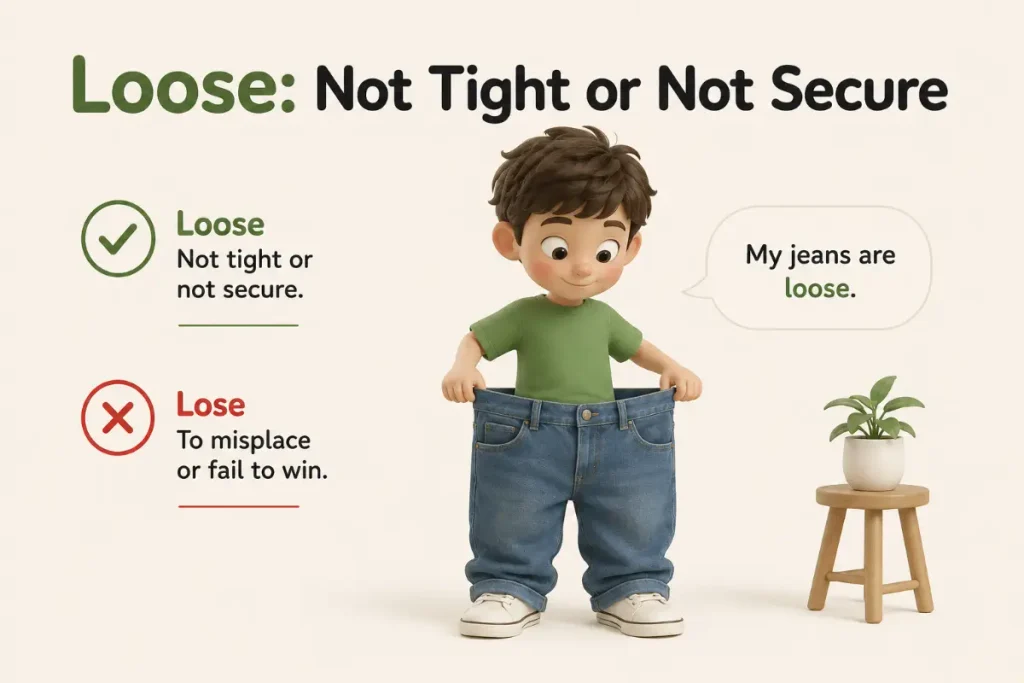
Loose: Not Tight or Not Secure
Loose primarily functions as an adjective, describing something not tightly held, fastened, or contained.
Examples:
- The dog got loose from its leash.
- She wore a loose, flowing dress.
- The bolts on the shelf are loose.
- He had loose change jingling in his pocket.
- Keep the reins loose while the horse walks.
Loose can also function as a verb, though this is less common in everyday writing, meaning “to release” or “to let fly”:
- The archer loosed an arrow toward the target.
- They loosed the dogs to search the field.
Lose: To Misplace or Fail to Win
Lose functions only as a verb, and it covers two closely related core meanings: failing to keep something, or failing to win.
Examples of “misplace” or “fail to keep”:
- I always lose my umbrella.
- Don’t lose your temper during the meeting.
- She’s worried she’ll lose her job in the layoffs.
- He didn’t want to lose touch with old friends.
Examples of “fail to win”:
- They’re going to lose the game if they don’t score soon.
- He hates to lose at chess.
- The team lost every match this season.
Lose is an irregular verb, and its past tense is “lost” — not “losed,” which isn’t a word at all. “Losing” is the present participle, keeping the same single-O pattern throughout every form of the word.
The Fastest Way to Check Yourself
Step 1: Read the word out loud. Does it rhyme with “goose” or “moose” (two syllables’ worth of “oo” sound)? That’s loose. Does it rhyme with “choose” or “snooze” (a shorter, softer “ooz” sound)? That’s lose.
Step 2: Count the O’s. Loose has two; lose has one. If you’re picturing the word and can’t decide, picture the meaning instead — losing something means it’s gone, reduced, diminished — and “lose” itself is the “reduced” spelling, missing a letter compared to what you might expect.
Step 3: Check the part of speech. If you need a verb describing misplacing something or failing to win, it’s almost certainly lose. If you need an adjective describing something not tight or secure, it’s loose.
A widely used memory trick: think of the sentence “if you lose one O, you spell it lose.” It sounds almost too simple, but it’s exactly the kind of self-referential trick that sticks precisely because it’s a little playful.
It’s a similar visual trap to principal and principle — words close enough in spelling that your eye can slide right past the difference unless you’re specifically checking for it.
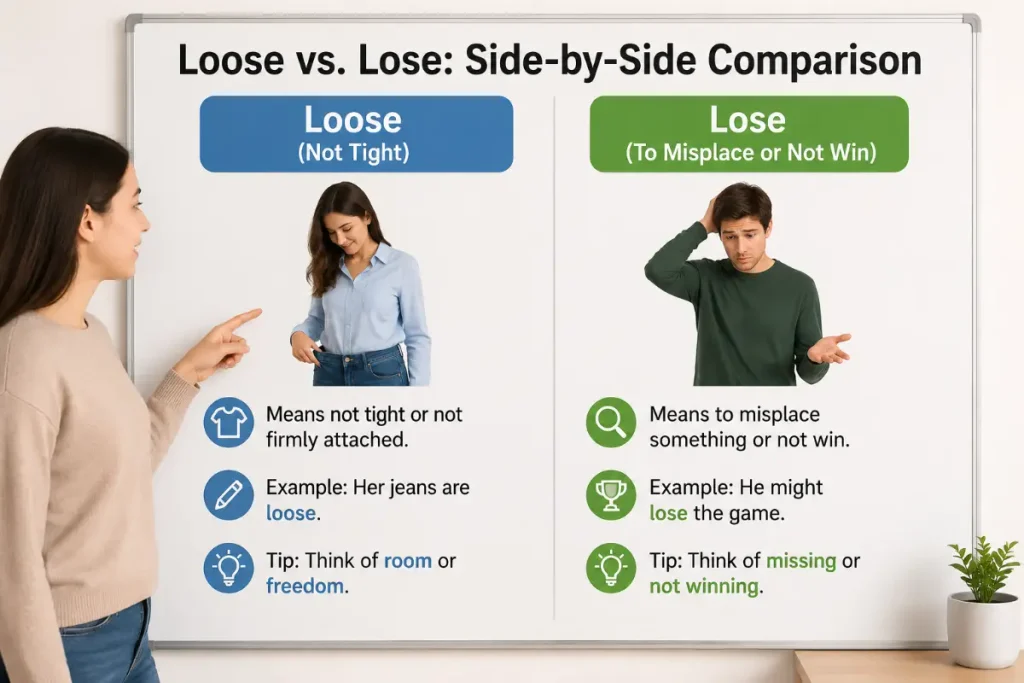
Loose vs. Lose: Side-by-Side Comparison
| Loose | Lose | |
|---|---|---|
| Number of O’s | Two | One |
| Rhymes with | Goose, moose | Choose, snooze |
| Part of speech | Adjective (mainly); rare verb | Verb only |
| Meaning | Not tight, not secure | To misplace or fail to win |
| Past tense | N/A (adjective) | Lost |
| Example | a loose button | lose your keys |
Common Mistakes People Make
Mistake 1: “I don’t want to loose this opportunity.” Should be “lose this opportunity” — this is about failing to keep or take advantage of something, which needs the verb “lose,” with one O.
Mistake 2: “The dog’s collar is too lose.” Should be “too loose” — this describes something not tight, which is the adjective “loose,” with two O’s.
Mistake 3: “She always looses her train of thought.” Should be “loses her train of thought” — this is describing misplacing focus, which needs “lose,” not “loose.”
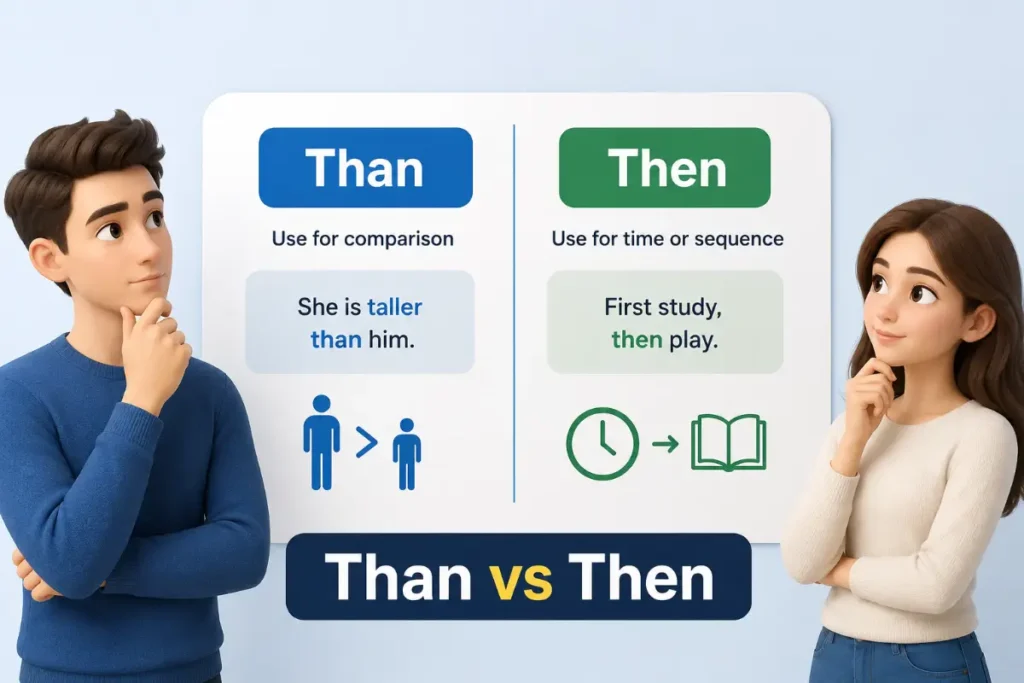
For another useful perspective, check out Than vs Then: The Simple Rule That Ends the Confusion (2026).
Mistake 4: “Don’t let the chickens get lose.” Should be “get loose” — this describes the chickens escaping restraint, the adjective use of “loose.”
Mistake 5: Assuming autocorrect will catch it. Because both words are correctly spelled on their own, spell-check won’t flag a wrong-but-valid choice. This is one of the more common typos that slips into published writing completely unnoticed, since the visual difference (one letter) is so small it’s easy to miss even on a careful read-through.
More Examples to Lock It In
- If you don’t tighten that bolt, it’ll come loose and you’ll lose the whole panel.
- She was afraid to lose the necklace, so she kept checking that the clasp wasn’t loose.
- The team played a loose, relaxed game but still managed to lose in overtime.
- He loosened his tie after a long day, relieved he hadn’t lost the client account.
- Keep a loose grip on the reins so you don’t lose control of the horse.
- I hate to lose track of time when I’m wearing such a comfortable, loose sweater.
What the Style Guides Say
Merriam-Webster explains that despite their spelling similarity, loose and lose are “quite distinct in meaning,” and specifically calls out that lose functions almost exclusively as a verb while loose spans multiple parts of speech — adjective, verb, and even occasionally noun and adverb. The dictionary notes the confusion largely comes down to the shared “oo” sound pattern clashing with people’s spelling instincts, rather than any real overlap in meaning. The AP Stylebook and Chicago Manual of Style both treat this as a standard, uncontested spelling distinction, with no gray area or usage debate to navigate.
Because this is purely a spelling issue rather than a genuine usage controversy, every major English-language authority handles it identically — the single most useful takeaway across all of them is the “lose has one O, and it’s the word that’s missing something” framing.
Loose and Lose in Different Writing Contexts
In everyday and casual writing, this is one of the most common typos, largely because both words look so similar and the error doesn’t disrupt the sentence’s meaning enough for most readers to consciously notice on a quick read.
In business and professional writing, “lose” appears constantly around risk, competition, and consequences (“lose a client,” “lose market share”), and a stray “loose” in that context can look like a careless typo in an otherwise polished document.
“Loose” (describing fit) is extremely common — loose-fitting, loose weave, loose sleeves — making this an industry where getting the adjective spelling right matters for basic product clarity in product descriptions and clothing/fashion writing,
In sports and competition writing, “lose” (failing to win) is one of the most frequently used verbs in the genre, and it’s worth double-checking specifically here since the stakes of the sentence (who won or lost) hinge entirely on getting the right word.
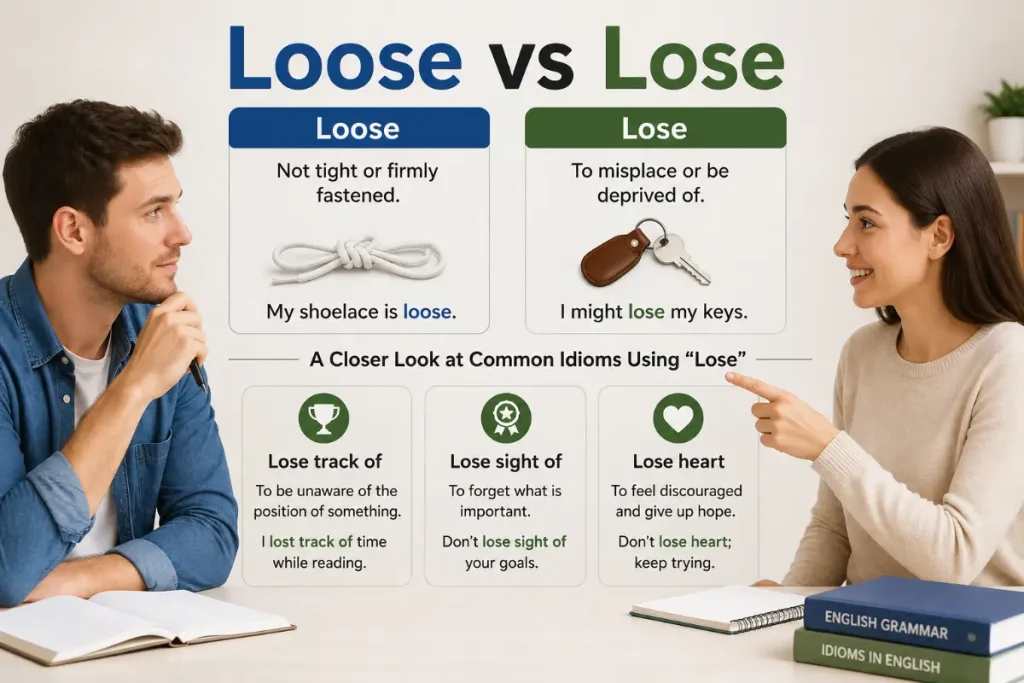
A Closer Look at Common Idioms Using “Lose”
Because “lose” appears in so many fixed phrases and idioms, it’s worth knowing a handful of the most common ones, since getting the spelling right matters even more in phrases readers will instantly recognize if something looks off.
- Lose your temper — to become angry
- Lose your train of thought — to forget what you were about to say
- Lose touch — to stop staying in contact with someone
- Lose face — to be embarrassed or lose others’ respect
- Lose your nerve — to become too afraid to do something you’d planned
- Lose track of time — to become so absorbed in something that you don’t notice how much time has passed
- Lose sleep over something — to worry about it excessively (often used in the negative: “I’m not losing any sleep over it”)
Every one of these idioms uses “lose” with its standard one-O spelling, and none of them have a “loose” equivalent — which makes sense, since all of them describe some version of losing control, focus, or connection, exactly the core meaning the verb carries throughout the language.
Frequently Asked Questions
Why does “lose” only have one O if it sounds like it should have two?
This is really just an accident of English spelling history rather than a logical rule — the word’s pronunciation evolved in a way that doesn’t match the more “expected” double-O pattern seen in similar-sounding words like “choose” and “goose.” It’s one of the clearer examples in English where sound and spelling simply don’t align intuitively, which is exactly why a dedicated memory trick helps more than trying to reason it out.
Is “loose” ever correct as a verb, or is that just a technicality?
It’s a genuine, if less common, usage meaning “to release or let fly” — as in “loose an arrow” or “loose the hounds.” You’ll encounter this more in literary, historical, or hunting-related writing than in everyday contexts, where the adjective sense (not tight) is far more common.
What’s the past tense of “lose,” and why isn’t it “losed”?
The past tense is “lost” — lose is an irregular verb, so it doesn’t follow the standard “-ed” pattern. “Losed” isn’t a recognized word in standard English at all.
Is there a connection between “loose” and “loosen”?
Yes — “loosen” is a related verb meaning to make something less tight or to release tension, built directly from “loose.” “Loosen your grip” and “the knot came loose” both relate to the same core adjective, just used in slightly different grammatical constructions.
What’s the fastest way to catch this error before publishing something?
Search your document for every instance of “loose” and “lose,” and for each one, read it aloud: does it rhyme with “goose” (loose) or “choose” (lose)? Since spell-check won’t catch a wrong-but-valid word, this quick read-aloud check is the most reliable method, and it works faster for this pair than for almost any other confusable pair on this site.
Practice Exercise
Fill in the blank with either “loose” or “lose.” Answers are listed right after — try each one before checking.
- Please don’t ______ your ticket before the show.
- The handle on this drawer is ______.
- They didn’t want to ______ the game in the final minute.
- Her hair was ______ and blowing in the wind.
- I always ______ my train of thought in noisy rooms.
- The dog slipped out of its ______ collar.
- He’s afraid to ______ his job during the layoffs.
- These jeans feel a little ______ around the waist.
- We can’t afford to ______ this client.
- The rope came ______ during the storm.
- She hates to ______ at board games.
- Tighten the screws before they get ______.
- Don’t ______ hope — we can still fix this.
- The horse ran ______ across the open field.
- He tends to ______ focus during long meetings.
- Her necklace clasp is dangerously ______.
- If we ______ this account, it’ll hurt the whole team.
- The children ran around in ______ clothing all day.
- I refuse to ______ my temper over something so small.
- The old fence board is ______ and needs fixing.
Answer Key
- lose
- loose
- lose
- loose
- lose
- loose
- lose
- loose
- lose
- loose
- lose
- loose
- lose
- loose
- lose
- loose
- lose
- loose
- lose
- loose
If you got sixteen or more correct, the rhyme test has already become instinct. For any you missed, read the sentence out loud again — this pair is one of the easier ones to self-correct just by listening.
Before moving on, you may also want to read I.e. vs E.g.: The Two-Second Trick to Never Mix Them Up in 2026 for more helpful grammar tips.
The Bottom Line
Loose (two O’s, rhymes with goose) means not tight or not secure. Lose (one O, rhymes with choose) means to misplace something or fail to win. The simplest way to remember it: lose is missing a letter compared to what you’d expect — fittingly, since losing is all about something going missing.
Once you understand Loose vs Lose, the difference becomes much easier to spot in everyday writing. Remember: loose describes something that isn’t firmly fixed, while lose refers to something going missing or failing to win. A quick spelling check can help you avoid this common mistake.