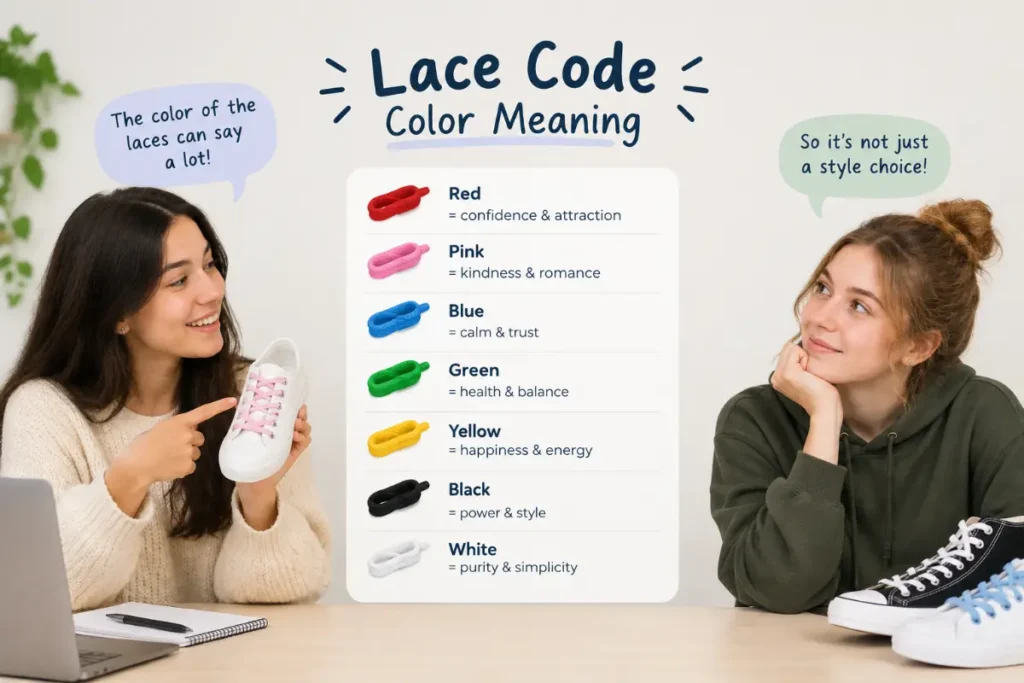
Lace code color meaning refers to the symbolic meanings associated with colored shoelaces in certain punk, skinhead, and alternative subcultures. Some colors have historically been linked to political beliefs, anti-racist movements, or LGBTQ+ identity. However, these meanings vary by community, location, and time period. Today, many people wear colored laces simply to match their outfits or personalize their boots.
If you have noticed colored laces on combat boots or Dr. Martens, you may wonder whether the colors carry a hidden message. The answer depends on the color, the surrounding symbols, and the cultural context.
For example, white and red laces have been associated with white supremacist or far-right groups in some historical scenes. Yellow laces have been linked to anti-racist skinhead communities, while purple has sometimes represented LGBTQ+ identity in alternative circles.
These associations are not universal rules. A person wearing a particular color is not automatically connected to the beliefs historically associated with it.
This guide explains the most commonly discussed lace code colors, their historical meanings, the role of lacing styles, and how to understand these symbols without making assumptions about others.
Quick Answer
Lace code color meaning refers to the symbolic messages associated with colored shoelaces in punk and skinhead subcultures. White and red laces have been linked to far-right symbolism in some historical scenes, yellow to anti-racist movements, and purple to LGBTQ+ expression in certain communities. However, meanings vary, and many people wear colored laces purely for fashion.
What Is Lace Code?
Lace code is an informal system in which people use shoelace colors to communicate messages within certain subcultures. It is most often discussed in connection with punk, skinhead, and alternative fashion, especially combat boots and other heavy footwear.
The practice became associated with youth subcultures in Britain and North America during the late 20th century. In some communities, people used colored laces to signal political affiliations, cultural identity, or membership in a particular scene.
However, lace code never had one official set of rules. Different groups developed different interpretations, and the same color could mean different things in different places.
For example, yellow laces have been associated with anti-racist movements in some communities, while white and red laces have carried far-right associations in certain historical settings. Other colors have less consistent meanings.
The way someone laces their boots may also matter. Some historical accounts connect particular colors with specific lacing methods, although those methods are also common fashion choices.
Today, lace code is less widely understood than it once was. Many people choose colored laces because they like the appearance, not because they want to send a political message.

Lace Code Color Meaning Chart
The following chart summarizes commonly reported associations. These are context-dependent interpretations, not universal definitions.
| Lace color | Commonly reported meaning | Important note |
|---|---|---|
| White | White-power or white supremacist symbolism in some scenes | Also widely used as a fashion choice |
| Red | Far-right or neo-Nazi associations in some historical contexts | Meanings vary between communities |
| Yellow | Anti-racist identity in some punk and skinhead scenes | Not a universal sign of activism |
| Blue | Specific political or anti-police associations in some accounts | The interpretation is inconsistent |
| Purple | LGBTQ+ identity or queer expression in some communities | Does not identify someone’s sexuality |
| Black | Traditional, neutral, or everyday footwear styling | Usually has no fixed political meaning |
| Green | Personal expression or community-specific symbolism | No widely accepted lace code meaning |
| Pink | Fashion or occasional queer-related expression | Often chosen simply for its appearance |
| Orange | Individual style or alternative fashion | No consistent historical meaning |
| Black and white | Sometimes linked to ska or particular subcultural styles | Depends on the design and community |
These meanings should be treated as historical associations rather than a reliable way to identify someone’s political beliefs. Lace code developed informally, and online charts sometimes present disputed interpretations as established facts.
White Shoelaces: What Do They Mean?
White shoelaces are among the most controversial colors discussed in lace code history.
In some punk and skinhead scenes, white laces became associated with white-power ideology and white supremacy. Certain far-right groups used clothing and footwear as visible markers of affiliation, and white laces formed part of that symbolism in some communities.
However, this association does not mean that everyone wearing white laces supports racist beliefs. White laces are common in mainstream footwear and can create a clean contrast against black combat boots.
The surrounding context matters. Historical interpretations may depend on the person’s community, other symbols they display, and the specific traditions of the scene.
Key takeaway: White laces have a documented association with white-power symbolism in certain historical subcultures, but the color alone does not establish someone’s beliefs.
Red Shoelaces: What Do They Symbolize?
Red laces have several reported meanings in alternative subcultures.
Some North American lace code accounts associate red laces with neo-Nazi or far-right affiliations. Other accounts connect them with violent political symbolism in particular skinhead scenes.
However, these interpretations are not consistent across all communities. Red can also represent solidarity, political identity, or personal style in other settings.
Outside these subcultures, red shoelaces are usually a fashion choice. People wear them to add contrast to dark boots, coordinate an outfit, or create a bold appearance.
Because the historical associations can be sensitive, it is useful to understand the context rather than assume that every person wearing red laces is communicating the same message.
Key takeaway: Red laces have been associated with far-right symbolism in some historical scenes, but their meaning is not universal.
Yellow Shoelaces: Anti-Racist Symbolism
Yellow laces are commonly associated with anti-racist skinhead and punk communities.
The skinhead subculture has never represented a single political ideology. While some factions adopted racist or far-right beliefs, other groups rejected those ideas and developed their own anti-racist identities.
One example is SHARP, which stands for Skinheads Against Racial Prejudice. This movement opposed racial prejudice within the skinhead scene. Yellow laces have been reported as a symbol of anti-racist affiliation in some communities.
For people familiar with this history, yellow laces may represent resistance to racism and support for inclusive alternative culture.
However, yellow is not an official or universal symbol of anti-racism. Someone might choose yellow laces simply because they like the color or want their boots to stand out.
Key takeaway: Yellow laces have been linked to anti-racist symbolism in certain communities, but the color alone does not prove a person’s political views.
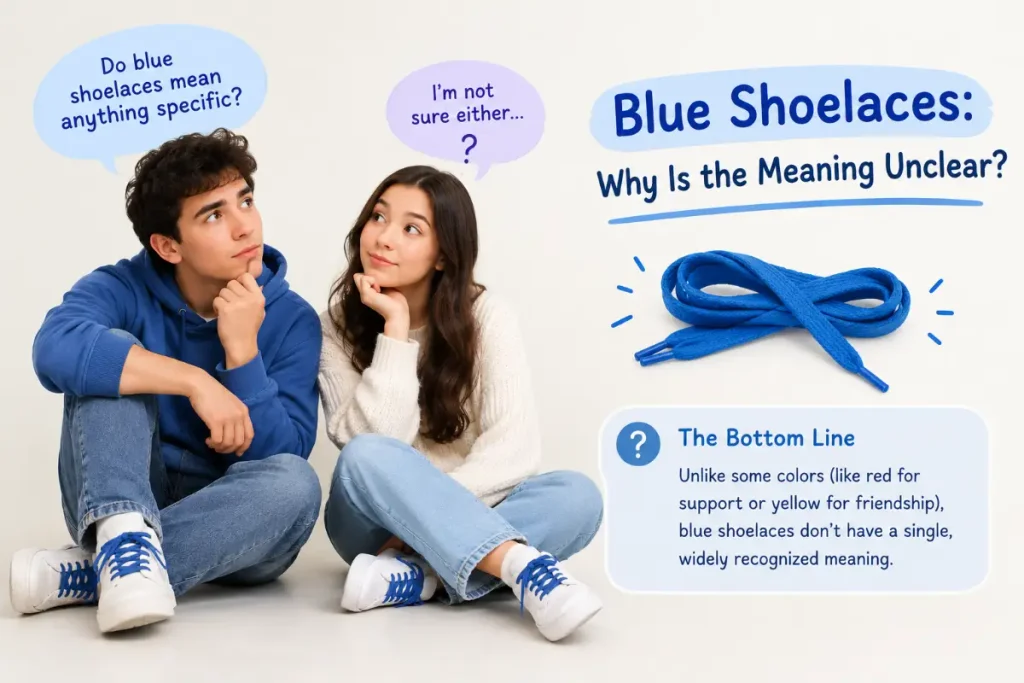
Blue Shoelaces: Why Is the Meaning Unclear?
Blue laces have a less consistent meaning than some other colors in lace code discussions.
Certain historical accounts associate blue laces with anti-police violence or specific political messages within particular skinhead contexts. These interpretations relate to certain groups rather than a universal rule followed by everyone who wears blue laces.
In other settings, blue may represent a favorite team, a personal preference, or a simple fashion choice.
Online charts sometimes repeat the same explanation without identifying its historical source or geographic context. This can make a limited association appear universal when it is not.
Key takeaway: Blue laces have been connected to specific political meanings in some accounts, but you should not assume that a person wearing them supports those ideas.
Purple Shoelaces: LGBTQ+ Pride and Identity
Purple laces have sometimes been associated with LGBTQ+ identity and queer expression in alternative communities.
Punk culture has often provided space for people to challenge social expectations through clothing, music, and personal expression. In some circles, purple laces have become part of that expression or a way to show solidarity.
However, purple is not a universal lace code symbol for LGBTQ+ identity. Many people wear purple because they like the color or want to create a distinctive look.
You also cannot determine someone’s sexuality or gender identity from their shoelaces. Even when a color has a symbolic meaning in a particular community, individual intentions can differ.
Key takeaway: Purple laces may carry LGBTQ+-related associations in some alternative scenes, but they do not reliably identify someone’s identity.
Black, Green, Pink, and Orange Shoelaces
Some lace code charts assign meanings to nearly every color. However, the evidence and consistency behind these interpretations vary considerably.
Black Shoelaces
Black laces are common on combat boots and other footwear. They match many outfits and often come with the shoes themselves.
Some historical descriptions associate black laces with traditional or non-political skinhead styling. In many other situations, they are simply a neutral fashion choice.
Green Shoelaces
Green laces do not have one widely accepted meaning across punk and skinhead communities. They may reflect personal expression, a local group’s symbolism, or a preference for colorful footwear.
Although green can suggest nature or environmental awareness in everyday settings, those associations do not automatically apply to lace code.
Pink Shoelaces
Pink laces are often used to personalize boots and sneakers. Some alternative communities may use pink as part of queer-related expression, but this is not a universal interpretation.
For most wearers, the color may simply match an outfit or reflect a personal preference.
Orange Shoelaces
Orange laces are generally associated with fashion rather than a widely recognized lace code meaning. They can create a bright contrast against black or brown boots.
A particular community may assign orange a special meaning, but that interpretation should not be applied to everyone.
Key takeaway: Black, green, pink, and orange laces have varied or limited historical associations. It is better not to assign a fixed meaning without clear cultural context.
Black-and-White Shoelaces: What Do They Represent?
Black-and-white laces sometimes appear in discussions of alternative fashion, ska culture, and racial unity.
Ska has a long history involving Jamaican musical influences and British youth culture. Black-and-white clothing and accessories have appeared in some ska-related styles, including checkerboard patterns.
However, black-and-white laces do not automatically communicate a political message. People may choose them because they match their footwear or create a two-tone appearance.
The design and local community matter more than the colors alone.
Key takeaway: Black-and-white laces may have cultural associations in certain scenes, but there is no universal meaning that applies to every wearer.
Does the Way You Lace Your Boots Matter?
Yes. In some historical interpretations, lace color was only one part of the message. The way someone threaded their laces could also carry significance.
One commonly discussed method is ladder lacing. Instead of crossing diagonally, the laces run horizontally across the boot, creating a ladder-like appearance.
Some accounts connect particular combinations of lace color and lacing style with political affiliations in certain skinhead communities. However, ladder lacing is also used for practical and aesthetic reasons.
Keep these points in mind:
- Color alone is not proof: A lace color cannot establish someone’s beliefs.
- Lacing style adds context: Certain combinations have carried historical associations in particular groups.
- Local traditions differ: A style recognized in one community may mean nothing in another.
- Fashion evolves: A style that once carried a message may later become common in mainstream fashion.
Lace code is best understood as a localized cultural practice, not a universal language that allows you to identify someone’s beliefs from their boots.
Where Did Lace Code Originate?
Lace code developed within the broader history of British skinhead and punk subcultures.
The original skinhead movement emerged in the late 1960s, drawing on working-class youth culture, mod fashion, Jamaican rude-boy influences, and music. Heavy boots became part of the recognizable style.
Over time, the skinhead label came to include groups with very different political beliefs. Some adopted racist or far-right ideologies, while others rejected racism and developed anti-racist identities.
These divisions made clothing and other visible symbols more politically significant in some communities. Colored laces offered a way to communicate an affiliation without displaying an obvious badge or slogan.
The practice spread through local scenes and personal experience rather than through a single organization that established official rules. As a result, interpretations differed across cities, countries, and generations.
This history helps explain why online lace code charts sometimes disagree. The meanings were never fully standardized, and some modern lists mix historical associations with newer interpretations.
Is Lace Code Still Used Today?
Lace code still appears in discussions of punk history, alternative fashion, and skinhead culture, but it is not widely understood as a universal system.
Some people deliberately choose colors to express a political belief, connect with a subculture, or show solidarity with a community. Others wear colored laces because they like the look.
Colored shoelaces are now common in mainstream fashion. Someone might choose red laces to brighten black boots or yellow laces because they match a jacket, without knowing their historical associations.
Online discussions can also create confusion by presenting old meanings as if they apply to every modern wearer.
The best approach is to recognize the history while understanding that the meaning depends on context and individual intention.
Lace Code vs. Hanky Code: What’s the Difference?
Lace code and hanky code are two separate systems associated with different subcultural histories.
| Feature | Lace code | Hanky code |
|---|---|---|
| Item used | Colored shoelaces | Colored handkerchiefs or bandanas |
| Historical setting | Punk and skinhead communities | LGBTQ+ and gay leather communities |
| Purpose | Signaling certain political or subcultural affiliations | Signaling sexual interests, preferences, or roles |
| Typical placement | Threaded through footwear | Traditionally worn visibly in a pocket or another position |
| Consistency | Informal and highly variable | Common charts exist, but meanings can vary |
The hanky code became particularly visible in gay leather communities during the 1970s. Colored bandanas could communicate particular sexual interests, and the pocket in which a bandana was worn could also affect its meaning.
Although both systems use color to communicate messages, they have different histories and purposes. A color’s meaning in the hanky code should not automatically be applied to shoelaces.
Common Misunderstandings About Lace Code
1. Every color has one fixed meaning. There is no universal lace code. Interpretations vary by community and historical period.
2. White laces always mean white supremacy. White laces have that association in certain historical scenes, but many people wear them for ordinary fashion reasons.
3. Red laces always indicate neo-Nazism. Red has been associated with far-right symbolism in some settings, but it has different meanings elsewhere.
4. Yellow laces always identify an anti-racist activist. Yellow has anti-racist associations in certain communities, but the color alone does not prove someone’s beliefs.
5. Lace code is followed everywhere today. Many people are unaware of the tradition and choose their laces for their appearance.
6. Lace code and hanky code are the same. They are different systems with distinct histories, symbols, and purposes.
7. Lacing style always reveals political affiliation. Certain styles have historical associations, but people also use them for comfort, practicality, and fashion.
Frequently Asked Questions
What does lace code mean?
Lace code is an informal system in which colored shoelaces have been used to signal political beliefs or subcultural affiliations, particularly in some punk and skinhead communities.
What does white lace code mean?
White laces have been associated with white-power ideology in certain historical scenes. However, white laces are also a common fashion choice and do not automatically indicate someone’s beliefs.
What does red lace code mean?
Red laces have been linked to far-right or neo-Nazi affiliations in some historical contexts. Their meaning varies between communities.
What do yellow shoelaces mean?
Yellow laces have been associated with anti-racist skinhead and punk communities. They can also be worn simply as a fashion choice.
What do purple shoelaces mean?
Purple laces have sometimes represented LGBTQ+ identity or queer expression in alternative communities, but they do not reliably identify someone’s sexuality or gender identity.
What do blue shoelaces mean?
Some historical accounts connect blue laces with particular political messages. These interpretations are inconsistent and should not be treated as universal.
Is lace code still relevant in 2026?
Lace code remains relevant in some subcultural and historical discussions, but most people do not follow a universal system when choosing shoelaces.
Are white or red laces offensive?
Neither color is inherently offensive. Both have been associated with far-right symbolism in certain historical settings, so context can affect how people interpret them.
Does ladder lacing have a special meaning?
Ladder lacing has been linked to certain historical lace code interpretations, but many people use it for appearance or practicality. The style alone does not establish political affiliation.
Should I avoid colored shoelaces?
Not necessarily. You can choose colors that suit your style while learning about their historical associations. If you participate in a particular subculture, consider its local traditions.
Conclusion
Understanding lace code color meaning requires more than memorizing a chart. White and red laces have been associated with far-right symbolism in some historical scenes, while yellow has been linked to anti-racist communities and purple to LGBTQ+-related expression in certain alternative circles.
However, lace code was never a universal system. Its meanings developed within specific communities and changed across places and generations. Today, many people choose colored laces simply to personalize their footwear.
If you want to wear colored laces, understanding their history can help you make an informed choice. And when you see someone else’s boots, remember that a color alone cannot tell you what that person believes.