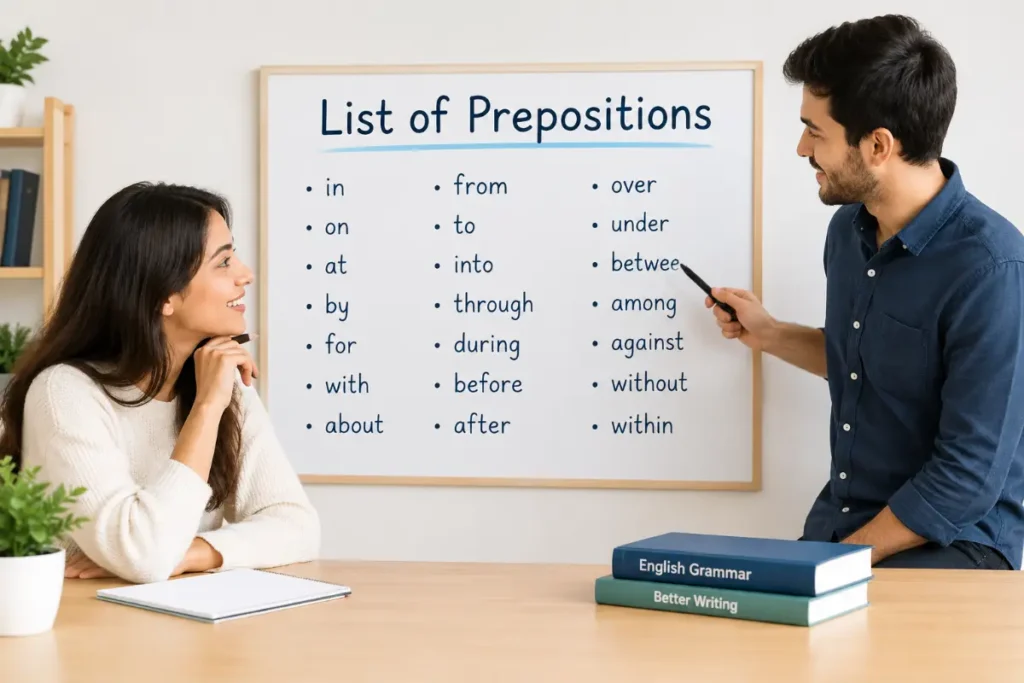
A useful list of prepositions is less about memorizing every single word and more about knowing the handful of categories they fall into, since prepositions all do one of a few jobs: showing time, place, direction, or a more abstract relationship between two things. Purdue OWL’s own materials on prepositions group them this exact way, by function rather than alphabetically, and that grouping is what actually makes a long list usable instead of just overwhelming.
This guide organizes the most common English prepositions into those functional groups, with example sentences for each, so you can find the right word for the relationship you’re trying to express rather than guessing from a giant undifferentiated list.
You may also find Types of Pronouns: 9 Essential Types With Easy Examples (2026) helpful if you want to explore this topic further.
What a Preposition Actually Does
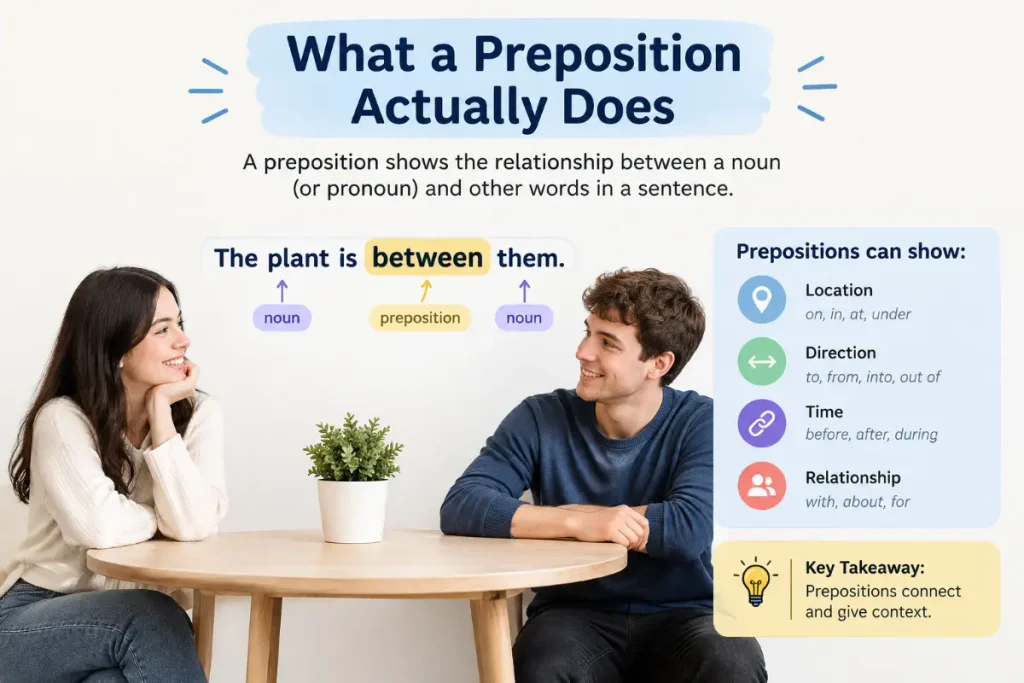
Purdue OWL’s prepositions handout defines prepositions as words or short phrases that show the spatial, directional, or temporal relationship between people or things — in plain terms, they connect a noun or pronoun to the rest of the sentence and explain how the two relate.
- The book is on the table. (spatial relationship)
- She left after dinner. (temporal relationship)
- He walked toward the door. (directional relationship)
Complete List of Prepositions in English (A–Z)
If you’re looking for a quick list of prepositions, the alphabetical format below makes it easier to find a specific word without searching through separate categories. These are common English prepositions and multi-word prepositions used in everyday speech and writing. Some can serve different grammatical functions depending on how they are used in a sentence.
| Preposition | Example |
|---|---|
| aboard | We climbed aboard the ship. |
| about | We talked about the new project. |
| above | The lamp hangs above the table. |
| across | She walked across the street. |
| after | We left after lunch. |
| against | He leaned against the wall. |
| along | They walked along the river. |
| amid | She remained calm amid the confusion. |
| among | He was sitting among his friends. |
| around | We walked around the park. |
| at | Meet me at the station. |
| before | Finish your work before dinner. |
| behind | The car is behind the house. |
| below | The temperature fell below zero. |
| beneath | The shoes were beneath the bed. |
| beside | She sat beside her sister. |
| between | The bank is between two stores. |
| beyond | The town lies beyond the mountains. |
| by | The book was written by Maya. |
| concerning | They asked questions concerning the policy. |
| despite | They went outside despite the rain. |
| down | He walked down the stairs. |
| during | Nobody spoke during the meeting. |
| except | Everyone came except John. |
| for | This gift is for you. |
| from | She traveled from Chicago. |
| in | The keys are in my bag. |
| inside | The children stayed inside the house. |
| into | He walked into the room. |
| like | She sings like a professional. |
| near | We live near the airport. |
| of | The cover of the book is blue. |
| off | The cup fell off the table. |
| on | Your phone is on the desk. |
| onto | The cat jumped onto the sofa. |
| opposite | The pharmacy is opposite the bank. |
| outside | They waited outside the building. |
| over | The plane flew over the city. |
| past | We drove past the school. |
| per | The workers are paid per hour. |
| regarding | I have a question regarding the schedule. |
| since | She has lived here since 2020. |
| through | We walked through the tunnel. |
| throughout | It rained throughout the night. |
| to | He went to the store. |
| toward | She walked toward the door. |
| under | The dog is under the table. |
| underneath | The wallet was underneath the cushion. |
| until | Wait here until noon. |
| up | He ran up the hill. |
| upon | Once upon a time, there was a king. |
| via | We traveled via train. |
| with | She went with her brother. |
| within | Please reply within three days. |
| without | He left without his phone. |
This isn’t an exhaustive inventory of every possible prepositional expression in English. English also has many multi-word or compound prepositions, such as according to, because of, in front of, instead of, in addition to, and on behalf of. Because different grammar references classify some borderline words and expressions differently, the exact number of English prepositions varies by source.
For practical writing, it is more useful to learn the common prepositions together with their meanings and example sentences than to memorize a fixed number. A word such as by, for example, can show an agent (written by Maya), a deadline (by Friday), or proximity (the house by the lake).
Prepositions of Time
These prepositions answer the question “when?”
- at — for a specific point in time: at noon, at midnight, at 3 p.m.
- on — for days and dates: on Monday, on July 4th
- in — for longer periods: in April, in 2024, in the morning
- since — for a starting point continuing to now: since 2010
- for — for a duration: for two hours
- by — for a deadline: by Friday
- before / after — for relative timing: before lunch, after the meeting
- during — for something happening within a period: during the storm
- until — for an end point: until midnight
- from…to — for a defined span: from Monday to Friday
Purdue OWL’s handout on time and place notes that “at” is specifically used with noon, night, midnight, and clock times — a useful shortcut when you’re unsure between “at,” “on,” and “in” for a time expression.
Prepositions of Place
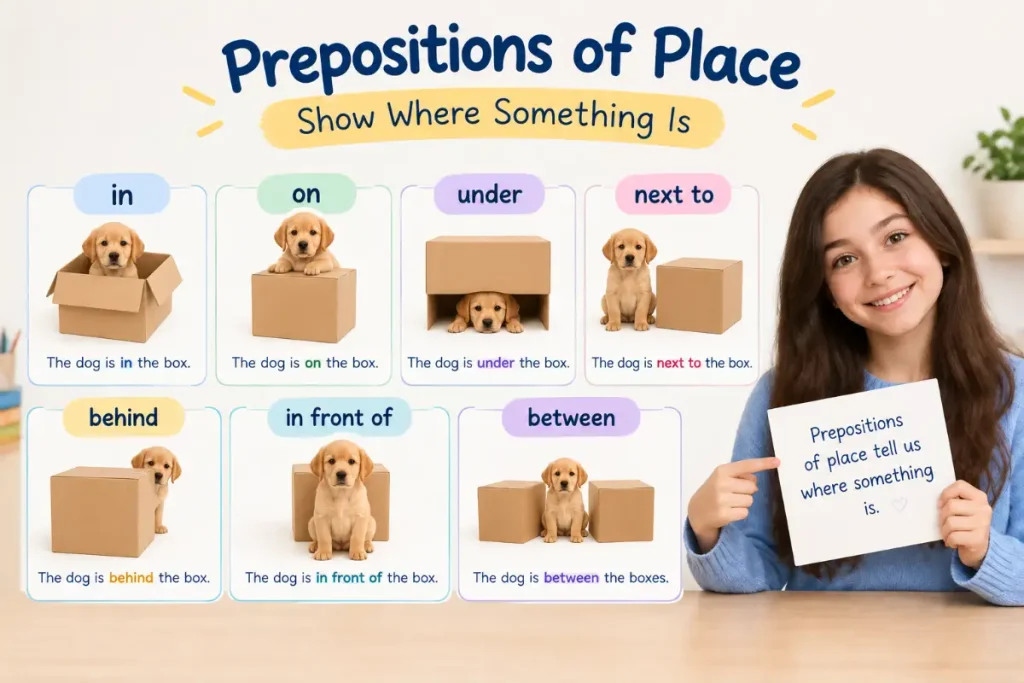
These answer the question “where?”
- at — a specific point: at the corner, at the door
- in — inside an area or volume: in the box, in the city
- on — on a surface: on the table, on the wall
- inside / outside — inside the house, outside the building
- near / by / next to — for proximity: near the station, by the window
- between — for two points: between the chairs
- among — for a group: among the crowd
- opposite — opposite the bank
Prepositions of Direction
These answer the question “which way?” and pair with verbs of motion rather than verbs describing a fixed state.
- to — toward a goal or destination: she walked to school
- into — toward the interior of a volume: he jumped into the pool
- onto — toward a surface: the cat climbed onto the roof
- toward / towards — general movement in a direction: we drove toward the coast
- through — passing from one side to the other: they walked through the tunnel
- across — from one side to the other of a flat area: she ran across the field
- along — following a line: he jogged along the river
- around — circling something: they walked around the block
- up / down — she climbed up the stairs; he went down the hill
- out of — he stepped out of the car
Purdue OWL points out that “to,” “into,” and “onto” correspond directly to the location prepositions “at,” “in,” and “on” — the direction word is simply the location word with movement added, which makes the whole set easier to remember as pairs rather than separate vocabulary.
Prepositions of Spatial Relationship
These describe a more specific physical position than the general place prepositions above.
- above / over — higher than a point: the plane flew above the clouds
- below / under / underneath / beneath — lower than a point: the cat hid under the bed
- behind — she parked behind the building
- in front of — he stood in front of the class
- beside — she sat beside her friend
- against — touching or in contact with: he leaned against the wall
Prepositions of Manner, Agent, and Instrument
These describe how something is done or by what means.
- by — showing the agent of an action, often in passive voice: the letter was written by Maria
- with — showing a tool or accompaniment: she cut it with scissors; he came with his brother
- without — he left without saying goodbye
- like — showing comparison or manner: she sings like a professional
- as — showing role or function: he works as a teacher
Prepositions That Introduce Objects of Certain Verbs
Some verbs are conventionally followed by a specific preposition, and there’s no logical shortcut for these — they simply need to be learned as pairs.
- listen to music
- depend on someone
- apologize for a mistake
- consist of several parts
- rely on a friend
- believe in a cause
- care about an issue
- deal with a problem
These fixed verb-preposition pairings show up constantly, and many of the words that follow them turn into gerunds, as covered in our guide to what is a gerund.
Compound and Multi-Word Prepositions
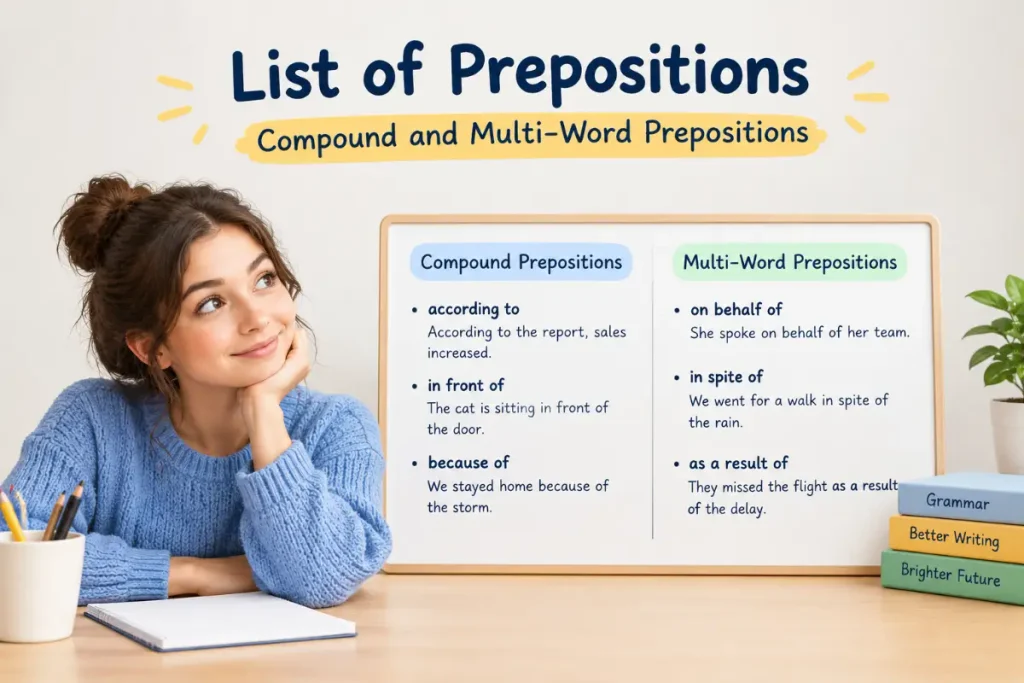
Beyond single-word prepositions, English also uses phrases that function the same way.
- because of — the game was postponed because of rain
- instead of — she chose tea instead of coffee
- according to — according to the report, sales rose
- in spite of / despite — they went out in spite of the rain
- on top of — the remote is on top of the fridge
- in addition to — in addition to rent, there’s a parking fee
- due to — the delay was due to weather
Prepositional Phrases: Examples and How They Work
A prepositional phrase is a group of words that begins with a preposition and ends with its object, usually a noun or pronoun. The phrase adds information about where, when, how, or why something happens.
For example:
- The keys are on the table.
- We arrived after lunch.
- She walked through the park.
- He went there with his brother.
In each example, the preposition connects its object to another part of the sentence. The phrase can appear at the beginning, middle, or end of a sentence.
At the end: We met at the restaurant.
At the beginning: After dinner, we watched a movie.
In the middle: The book on the desk belongs to Sarah.
Prepositional phrases can also contain another prepositional phrase:
- The keys are on the table near the window.
Here, on the table and near the window both provide additional information.
Learning to recognize prepositional phrases can make a list of prepositions easier to use because you can see how individual prepositions work in complete sentences rather than memorizing them in isolation.
Prepositions Used With Adjectives
Some adjectives are commonly followed by particular prepositions. These combinations are often called adjective-preposition combinations, and the correct preposition usually needs to be learned with the adjective.
Here are some common examples:
| Adjective | Preposition | Example |
|---|---|---|
| afraid | of | She is afraid of spiders. |
| interested | in | He is interested in history. |
| good | at | Maria is good at math. |
| proud | of | They are proud of their son. |
| responsible | for | She is responsible for the project. |
| familiar | with | Are you familiar with this book? |
| different | from | This answer is different from mine. |
| similar | to | Your idea is similar to mine. |
| angry | with | He was angry with his brother. |
| excited | about | We are excited about the trip. |
A common mistake is choosing a preposition that sounds logical but does not normally belong with the adjective. For example, standard English uses interested in, not interested on.
The best way to learn these combinations is to remember the adjective and preposition together. Instead of memorizing interested by itself, learn interested in as one useful combination.
Common Verb + Preposition Combinations
Many English verbs are commonly followed by specific prepositions. The correct combination is not always predictable, so learning the verb and preposition together can help you avoid common mistakes.
Here are some frequently used combinations:
| Verb + Preposition | Example |
|---|---|
| agree with | I agree with you. |
| apologize for | She apologized for being late. |
| believe in | They believe in hard work. |
| care about | He cares about his family. |
| depend on | It depends on the weather. |
| listen to | Please listen to the instructions. |
| look at | She looked at the picture. |
| pay for | I paid for the meal. |
| rely on | We rely on public transportation. |
| speak to | I need to speak to the manager. |
| think about | He is thinking about the problem. |
| wait for | We waited for the bus. |
Be careful not to translate these combinations word for word from another language. For example, standard English uses listen to music, not listen music, and depend on someone, not depend of someone.
When you’re unsure, check the complete phrase rather than looking up the verb alone. Over time, repeated exposure will make common verb-preposition combinations easier to recognize.
Prepositions vs. Adverbs: What’s the Difference?
Some words can function as either prepositions or adverbs, depending on how they are used in a sentence. Words such as in, out, up, down, around, and off can have either role.
The easiest way to tell the difference is to check whether the word introduces an object.
Preposition: The children ran outside the house.
Here, outside is followed by the noun phrase the house, so it functions as a preposition.
Adverb: The children ran outside.
Here, outside has no object after it and tells us where the children ran, so it functions as an adverb.
For another useful perspective, check out An Adverb? 25 Easy Examples to Understand It (2026).
Compare these examples:
- She walked up the stairs. → preposition
- She walked up. → adverb
- He jumped off the table. → preposition
- He jumped off. → adverb
The word itself does not determine its grammatical role. You need to look at how it functions in the particular sentence.
Quick Reference Table by Category
| Category | Examples |
|---|---|
| Time | at, on, in, since, for, by, before, after, during, until |
| Place | at, in, on, inside, outside, near, between, among |
| Direction | to, into, onto, toward, through, across, along, around |
| Spatial relationship | above, below, behind, in front of, beside, against |
| Manner/agent | by, with, without, like, as |
| Fixed verb pairings | listen to, depend on, apologize for, consist of |
| Compound prepositions | because of, instead of, according to, despite |
Common Mistakes People Make
Mistake 1: Using “in” for a specific clock time instead of “at,” as in “in 3 p.m.” instead of “at 3 p.m.”
Mistake 2: Confusing “since” and “for.” “Since” marks a starting point (“since 2020”), while “for” marks a duration (“for five years”).
Mistake 3: Mixing up “into” and “in to.” “She walked into the room” describes movement; “she walked in to see him” is a verb plus a separate infinitive, and they aren’t interchangeable.
Mistake 4: Pairing a verb with the wrong fixed preposition, such as “married with” instead of “married to,” a common error worth double-checking.
Mistake 5: Ending a sentence with an unnecessary preposition, as in “Where is the library at?” instead of simply “Where is the library?”
Practice Exercise
Choose the correct preposition for each sentence. Answers are listed right after, so try each one before checking.
- The meeting starts ___ 9 a.m.
- She was born ___ 1990.
- We’ll be there ___ Friday.
- He’s been studying ___ three hours.
- She’s lived here ___ 2015.
- The cat jumped ___ the couch.
- He drove ___ the tunnel.
- The keys are ___ the table.
- She sat ___ her sister at dinner.
- The dog ran ___ the yard.
- He apologized ___ being late.
- This recipe consists ___ five ingredients.
- She’s afraid ___ spiders.
- The picture is hanging ___ the wall.
- He walked ___ the store to buy milk.
- The train arrives ___ noon.
- They canceled the picnic ___ the rain.
- She’s responsible ___ the budget.
- The remote is ___ the coffee table.
- He’s been waiting ___ an hour.
Answer Key
- at
- in
- by (or “on,” depending on meaning)
- for
- since
- onto
- through
- on
- beside
- around (or “through,” “across”)
- for
- of
- of
- on
- to
- at
- because of
- for
- on
- for
Frequently Asked Questions
How many prepositions are there in English?
There’s no single agreed-upon number, since compound and multi-word prepositions blur the count, but most everyday writing relies on a core set of fewer than a hundred single-word prepositions, with “at,” “in,” “on,” “to,” “for,” “with,” and “by” among the most frequently used.
Is it really wrong to end a sentence with a preposition?
No. This is a long-debunked myth similar to the split infinitive rule. “Who did you go with?” is standard, natural English, even though some older style guides discouraged it based on Latin grammar that doesn’t actually apply to English.
How can I remember which preposition pairs with which verb?
There’s no universal shortcut. These verb-preposition pairings are learned individually through reading and exposure, which is why keeping a running list of the ones you personally mix up is often more useful than trying to memorize an exhaustive list all at once.
What’s the difference between a preposition and a conjunction like “since” or “after”?
The same word can function as either, depending on what follows it. If “since” or “after” is followed by just a noun (“since Monday”), it’s a preposition. If it’s followed by a full clause with its own subject and verb (“since she arrived”), it’s functioning as a subordinating conjunction instead.
What’s the fastest way to check if I’ve used the right preposition?
Identify the category of relationship you’re expressing — time, place, direction, or a fixed verb pairing — and check that word against the list for that specific category, since prepositions rarely translate directly and logically from one language or even one dialect of English to another.
Before moving on, you may also want to read A Linking Verb? Easy Guide And 15+ Examples (2026) for more helpful grammar tips.
Wrapping Up
A list of prepositions is most useful when it’s organized by function rather than presented as one long alphabetical block, since the categories of time, place, direction, spatial relationship, and fixed verb pairings each have their own internal logic worth learning together. Once you know which category a sentence calls for, narrowing down the right preposition becomes far more manageable.
The fixed verb-preposition pairings are the part most worth returning to over time, since they don’t follow a predictable rule and are best picked up through repeated exposure and correction rather than memorized in one sitting.